The idea
A conv layer's output is a feature map of shape C x H x W: C channels over an H x W grid. Attention transfer squashes it to one H x W map of where the network is active, by summing squared activations over channels. The student is trained to make its maps match the teacher's at a few chosen depths. The channel dimension is gone, so a narrow student can match a wide teacher without an extra projection layer.
How it works
- Pick layer pairs, one in the teacher and one in the student, with the same H x W, for example the end of each resolution stage.
- For a feature map
A(batch B x C x H x W):Q = sum over c of A[:, c]², shape B x H x W. Flatten to B x HW and normalize each row:q = Q / ||Q||. - Pair loss:
||q_s - q_t||², averaged over the batch. - Total:
L = task_loss + beta * Σ_pairs pair_loss. Normalized maps differ by small amounts, sobetamust be large enough for this term to matter next to the task loss.
def attention(f):                                  # f: B x C x H x W
    return F.normalize(f.pow(2).mean(1).flatten(1), dim=1)   # B x HW

loss = task_loss(student_out, targets)
for fs, ft in zip(student_feats, teacher_feats):   # captured with forward hooks
    if fs.shape[-2:] != ft.shape[-2:]:
        fs = F.interpolate(fs, size=ft.shape[-2:], mode="bilinear")
    loss = loss + beta * (attention(fs) - attention(ft.detach())).pow(2).sum(1).mean()
The code, line by line
Hint in lab/train.py is FitNets, an earlier feature-matching loss. hs, ht = hid[self.s], b.t_hidden[self.t] picks the student and teacher hidden layers. r = hs @ self.P - ht is the residual after a learned projection P (student width x teacher width). The loss is self.w * (r ** 2).mean(). self.dP = self.w * hs.T @ (2 * r / n) is its gradient for P, and dh = self.w * (2 * r / n) @ self.P.T is the gradient sent into the student layer, returned as {self.s: dh} with a zero logit gradient. Attention transfer replaces hs @ self.P - ht with attention(hs) - attention(ht) and drops P: nothing to learn, because the channel sum already removes the width mismatch.
What the simulations show
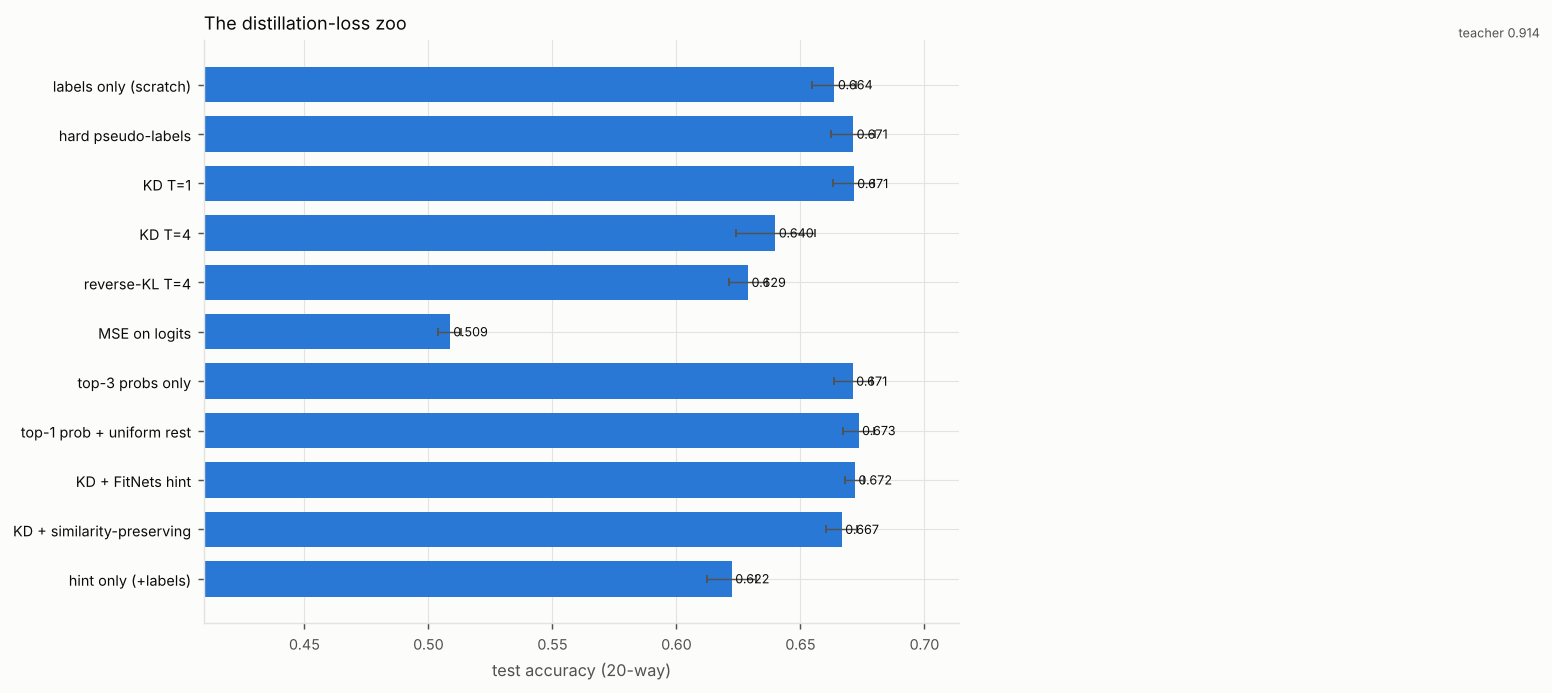
Toy-MLP analogue, not YOLO: loss_zoo (lab/results/loss_zoo.json). Adding a FitNets hint to KD gave accuracy 0.6395, against 0.6398 for KD alone; hint plus labels gave 0.6223, against 0.6637 for labels alone. Feature matching added nothing here. An MLP has no spatial grid, so an attention map can't be formed at all.
When it breaks
- Map sizes must match; for a detector, pair the P3, P4 and P5 neck outputs.
- The map keeps where, not what. A student can fire in the right place with the wrong features.
- Pairing a shallow student layer with a deep teacher layer forces the wrong job on it.
Going further
Missing here: a torch loop running teacher and student together with hooks, and a trainer whose loss accepts extra terms. The YOLOv8n cockpit's pruned student has the teacher's layout, so spatial sizes line up at every stage. The closest analogue is Hint.
Source code
This method doesn't run here. Below is the closest code the lab does run, read from the repository when this page was built.
Hint lab/train.py:229
class Hint:
    """FitNets: regress a student hidden layer onto a teacher hidden layer
    through a learned linear projection (student width -> teacher width)."""

    def __init__(self, s_layer: int, t_layer: int, d_s: int, d_t: int, weight: float = 1.0,
                 seed: int = 0):
        rng = np.random.default_rng(seed)
        self.s, self.t, self.w = s_layer, t_layer, weight
        self.P = (rng.standard_normal((d_s, d_t)) / np.sqrt(d_s)).astype(F)
        self.dP = np.zeros_like(self.P)

    def params(self):
        return [self.P]

    def __call__(self, z, hid, b: Batch):
        hs, ht = hid[self.s], b.t_hidden[self.t]
        r = hs @ self.P - ht
        n = r.size
        self.dP = self.w * hs.T @ (2 * r / n)
        dh = self.w * (2 * r / n) @ self.P.T
        return self.w * (r ** 2).mean(), np.zeros_like(z), {self.s: dh}
Simulation figures
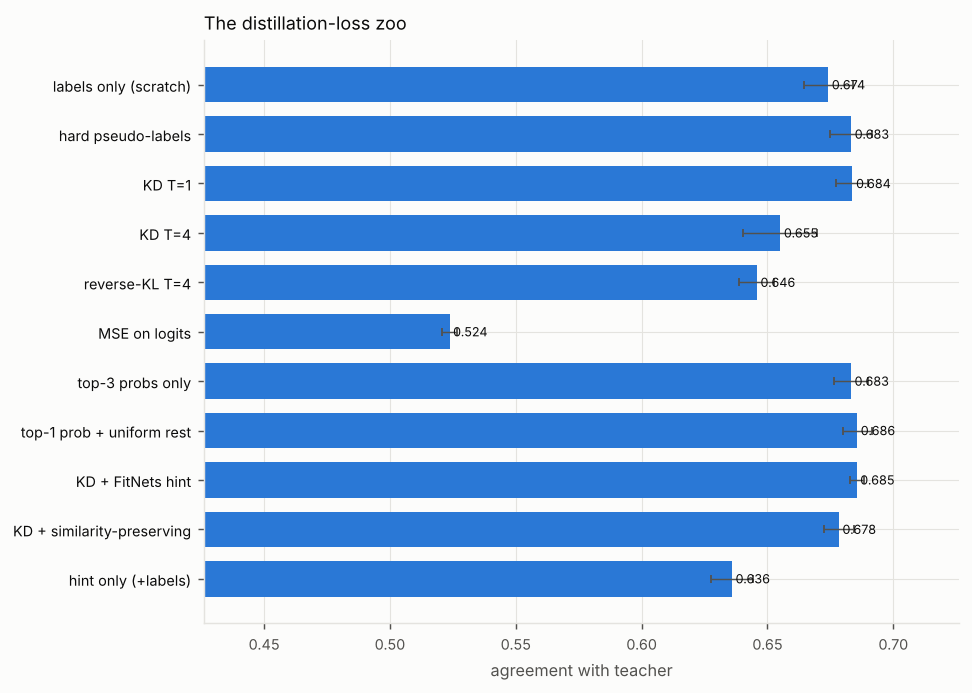
The distillation-loss zoo
Same student, same teacher, same inputs: which form of teacher signal transfers the most? (logits, probabilities, top-k only, hard labels, hidden features, relational structure)
This figure did not load: the file is missing or the connection dropped. Reload the page to try again; the experiment's full table on the Results page has the same numbers.
This figure did not load: the file is missing or the connection dropped. Reload the page to try again; the experiment's full table on the Results page has the same numbers.
Papers
- Zagoruyko & Komodakis. Paying More Attention to Attention (2017)