The idea
A convolution layer outputs a stack of feature maps called channels, one per filter. Deleting a channel removes that filter and one input slice of every layer that reads it, so the model gets smaller and does less arithmetic. With residual adds and concatenations, one channel is read by several layers, and all of them must lose it together or the shapes stop matching. That set is a dependency group. The torch-pruning library finds the groups by tracing the network; the YOLOv8n cockpit adds one rewrite so YOLOv8's main block can be traced.
How it works
- Rewrite: replace each Ultralytics
C2fblock withC2f_v2, which computes the same thing in a form the tracer can follow. - Trace: mark every weight as trainable, switch to training mode, and run one example image through the model. torch-pruning follows the autograd graph to record which layer feeds which.
- Group: for each output channel, collect everything tied to it: the conv filter, its batch-norm (BN) entries, the input slice of each consumer, and anything joined by a residual add or a concatenation.
- Score each channel in a group by the size of its weights (an L2, sum-of-squares criterion), combined across all the group's layers. A small score means little signal flows through it.
- Remove the lowest-scoring fraction of every group by slicing the tensors, so they physically shrink. The fraction is either one number for the whole model or one per stage.
- Never remove output channels of the Detect head (the layer that emits boxes and class scores).
Example: YOLOv8's Bottleneck computes x + cv2(cv1(x)). Cutting channel 7 from cv2's output forces cutting channel 7 from x, and so from the layer that produced x and every layer that reads it.
The code, line by line
C2f splits one 1x1 conv's output in half with chunk(2, 1); the module docstring records that the tracer can't follow it, so a generic pruner removes zero channels.
C2f_v2.__init__ builds two convs instead, self.cv0 and self.cv1, each producing self.c = int(c2 * e) channels. self.cv2 maps the concatenation of 2 + n branches back to c2 channels. forward builds y = [self.cv0(x), self.cv1(x)], runs each Bottleneck on the newest entry (y.extend(m(y[-1]) for m in self.m)) and returns self.cv2(torch.cat(y, 1)). Every split is now a separate layer the tracer can see.
transfer_weights makes the swap exact: it reuses the old cv2 and m, gives old_weight[:half] of cv1.conv.weight to cv0 and old_weight[half:] to cv1, splits the BN tensors the same way, and copies plain attributes such as c and Ultralytics' routing tags f and i. make_prunable swaps every C2f in yolo.model.
Both prune functions build their pruner with _pruner:
model.requires_grad_(True)comes first. Ultralytics checkpoints load withrequires_grad=False, and the tracer only sees layers autograd tracks. The docstring records the two failures this fixes: a reloaded checkpoint pruned nothing, and a fresh model never pruned stages 0-1, which sit before the first newly builtC2f_v2.ignoredlists everyDetectmodule, so the head's outputs are never cut.getattr(tp.pruner, "GroupNormPruner", tp.pruner.MetaPruner)uses whichever class the installed torch-pruning has.GroupMagnitudeImportance()does the scoring.model.train()runs before construction, because in training mode the head returns raw feature maps, which trace cleanly. Thefinallyblock restores the old mode withmodel.train(was).iterative_steps=1means the whole ratio comes off in onestep().
structured_prune(yolo, ratio) is one line, _pruner(yolo.model, example, pruning_ratio=ratio).step(): every group loses the same fraction. The headless scripts (prune_sweep.py, finetune.py, iterative_prune.py) use it.
structured_prune_per_stage(yolo, stage_fracs) is what the cockpit's Export and Regrow call. _stage_pruner collects head, the ids of every module inside Detect. For each other Conv2d, top_stage(name) maps model.5.cv1.conv to model.5; if that stage has a fraction, the conv goes into ratio_dict with min(float(stage_fracs[st]), 0.9), a cap that keeps a stage from vanishing. pruning_ratio=0.0 leaves every other group alone. Groups cross stage boundaries, so cutting one stage's outputs also shrinks the next stage's inputs. removal_plan builds the same pruner to list the channels without removing them (see prune_and_regrow).
What the simulations show
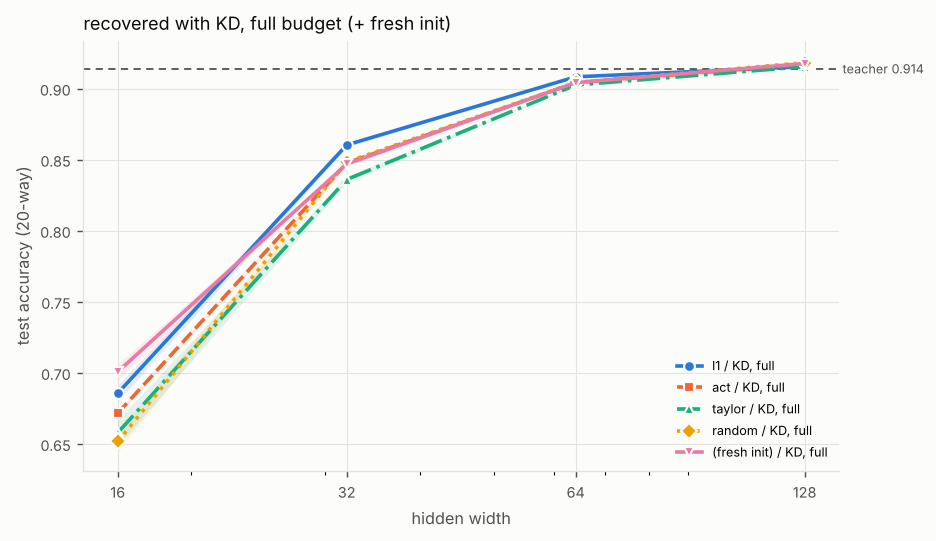
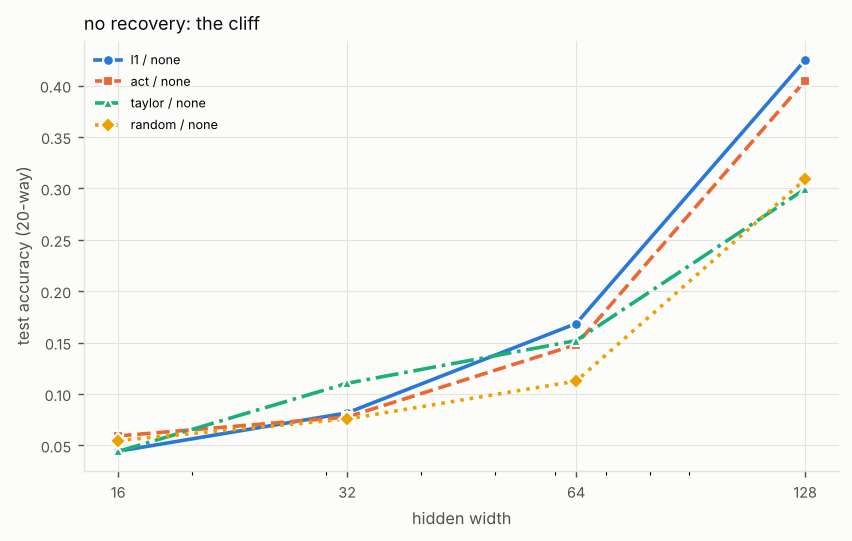
The toy-MLP analogue, not YOLO, is prune_structured (lab/results/prune_structured.json). A 3x256 MLP teacher loses whole neurons, ranked by L1 weight norm, then gets no recovery, fine-tuning on labels, or distillation from the teacher (KD) for 3,000 steps, the same budget as training fresh. Accuracy on 20 classes; recovered numbers are 2-seed means.
| hidden width | no recovery | labels | KD | fresh net, KD |
|---|---|---|---|---|
| 128 | 0.4247 | 0.9091 | 0.9155 | 0.9176 |
| 64 | 0.1685 | 0.8909 | 0.90825 | 0.9042 |
| 32 | 0.0816 | 0.8426 | 0.86035 | 0.8469 |
| 16 | 0.0443 | 0.68005 | 0.68565 | 0.70075 |
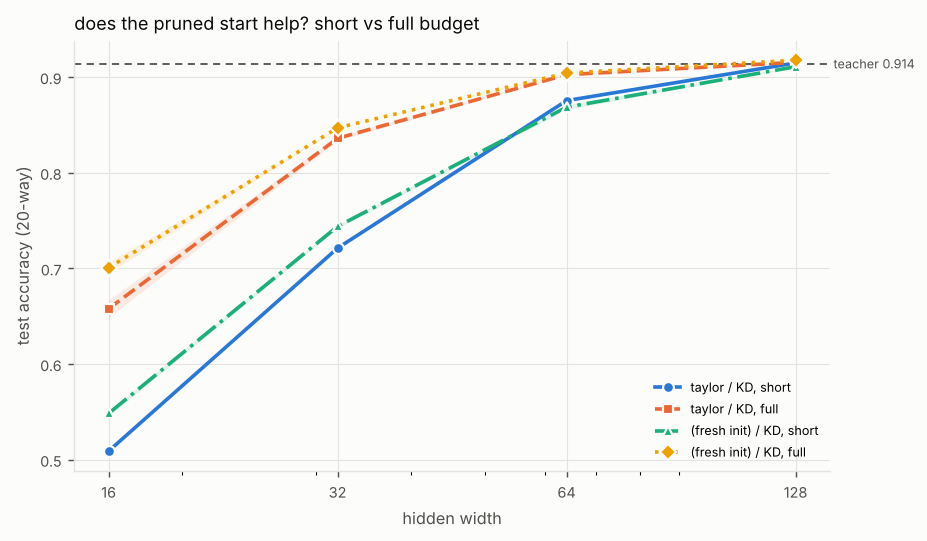
Halving the width with no recovery drops accuracy to 0.4247, the same kind of cliff the detector shows. After recovery the ranking rule mattered little: at width 128 with KD, L1, activation, Taylor and random ranking land between 0.9154 and 0.9182. With 750 steps instead, the pruned start was ahead at width 64 (0.8927 against 0.86855 for a fresh net). An MLP has no adds or concatenations, so the toy says nothing about dependency groups.
When it breaks
- One-shot cuts fall off a cliff. STATUS.md records bird mAP@50 of 0.000 after a uniform 5% prune, still 0.000 at 5, 10, 20 and 30% after the
requires_gradfix. Always fine-tune afterwards. - Where you cut matters. Unfine-tuned on 125 images, stage 0 at 25% scores 0.4100 and stage 9 at 30% scores 0.1265 (STATUS.md).
- Fewer operations did not mean faster on a Mac. STATUS.md records a 30% prune that cut MACs (multiply-accumulates) by 35% yet made MPS latency 6% worse. After the
requires_gradfix the same prune gives 1.81M params and 2.78G MACs, from 3.16M and 4.40G. - Only YOLOv8's
C2fhas a traceable rewrite. YOLO11'sC3k2andC2PSAblocks have none. transfer_weightsreadscv1.bn, somake_prunablemust run beforefusefolds BN into the convs. server.py does it in that order.- Coupling makes a cut's saving hard to guess: STATUS.md records stages 15 and 21 at 25% once estimated at 2% of compute saved, while Export saved 8%.
Going further
To run it, install requirements.txt, run python build_eval_set.py, then uvicorn server:app --port 8000 --app-dir . and open http://localhost:8000. In Structure, press Scan (it masks 10% of each stage and measures the drop), then "Apply cut" or click nodes (each is 5% of a stage's channels). "Export real pruned model" posts to /api/export, which prunes a fresh yolov8n.pt with structured_prune_per_stage, reports params, GMACs, latency and real mAP before regrow, and saves runs/pigeon_pruned.pt. The toy version is lab/compress.py:structured_prune.
Source code
The exact code the cockpit runs, read from the repository when this page was built.
structured_prune cockpit/harness/prune.py:165
def structured_prune(yolo, ratio: float, example: torch.Tensor | None = None) -> None:
    """Really remove `ratio` of each prunable group's channels (local L2
    ranking, every group cut by the same ratio), sparing the Detect head.
    Call `make_prunable(yolo)` once before the first prune.
    """
    _pruner(yolo.model, example, pruning_ratio=ratio).step()
structured_prune_per_stage cockpit/harness/prune.py:134
def structured_prune_per_stage(yolo, stage_fracs: dict[str, float],
                               example: torch.Tensor | None = None) -> None:
    """Real removal that honors per-stage fractions (dict stage -> frac), so the
    UI's per-column masks become a real, placement-aware pruned model. Call
    make_prunable(yolo) once first.
    """
    _stage_pruner(yolo.model, stage_fracs, example).step()
C2f_v2 cockpit/harness/prune.py:23
class C2f_v2(nn.Module):
    """C2f with cv1's chunk() split into two explicit conv branches (cv0, cv1)."""

    def __init__(self, c1, c2, n=1, shortcut=False, g=1, e=0.5):
        super().__init__()
        self.c = int(c2 * e)
        self.cv0 = Conv(c1, self.c, 1, 1)
        self.cv1 = Conv(c1, self.c, 1, 1)
        self.cv2 = Conv((2 + n) * self.c, c2, 1)
        self.m = nn.ModuleList(
            Bottleneck(self.c, self.c, shortcut, g, k=((3, 3), (3, 3)), e=1.0)
            for _ in range(n)
        )

    def forward(self, x):
        y = [self.cv0(x), self.cv1(x)]
        y.extend(m(y[-1]) for m in self.m)
        return self.cv2(torch.cat(y, 1))
Simulation figures
Structured (neuron) pruning: criteria, recovery, budget
Delete whole neurons so the net is genuinely smaller. Which importance criterion picks the right ones, and is a pruned teacher a head start over training the small shape fresh, at the same number of training steps?
This figure did not load: the file is missing or the connection dropped. Reload the page to try again; the experiment's full table on the Results page has the same numbers.
This figure did not load: the file is missing or the connection dropped. Reload the page to try again; the experiment's full table on the Results page has the same numbers.
This figure did not load: the file is missing or the connection dropped. Reload the page to try again; the experiment's full table on the Results page has the same numbers.
'short' = 750 steps, 'full' = 3000 steps; pruned and fresh nets use the same optimizer and learning rate, so the only difference is the starting weights.
Full table: Structured (neuron) pruning: criteria, recovery, budget
Papers
- Fang et al. DepGraph: Towards Any Structural Pruning (2023)