The idea
Quantization stores each weight in fewer bits, for example as an 8-bit integer instead of a 16-bit float. The YOLOv8n cockpit measures the cost with fake quantization: round every weight to the nearest value an N-bit format could hold, but keep it as a float. The normal forward pass then gives the accuracy a real N-bit export with the same scheme would have. What keeps low bit-widths alive is the shared scale: each group of weights gets one float multiplier, and smaller groups fit their weights more tightly. For a CNN, round the weights inference actually uses, which means folding batch norm into each conv first.
How it works
- Fuse: fold each batch-norm (BN) layer into the conv before it, so
w' = w * γ / sqrt(var + eps)per output channel and the BN shift becomes the conv's bias (see bn_folding). - Flatten the weight tensor and cut it into groups of
group_sizeconsecutive values, or use one group for the whole tensor (per-tensor). - For each group,
scale = max(|w|) / qmax, whereqmax = 2^(bits-1) - 1(127 at 8 bits, 7 at 4 bits). q = clamp(round(w / scale), -qmax, qmax)is the integer a real file would store, andw_hat = q * scaleis the float the model uses.- At 1 bit there is no zero level:
w_hat = sign(w) * mean(|w|).
Example at 4 bits, one group [0.50, -0.20, 0.03]: scale = 0.5 / 7 ≈ 0.0714, q = [7, -3, 0], w_hat = [0.50, -0.214, 0.0]. The 0.03 vanished: the largest weight sets the step for the whole group.
The code, line by line
fuse(yolo) in harness/model.py calls Ultralytics' yolo.model.fuse(verbose=False) unless yolo.model.is_fused(), folding every BN into its conv in place; calling it twice is harmless. It is explicit because newer Ultralytics predict() fuses a private copy and leaves yolo.model unfused. STATUS.md records that before this fix the cockpit rounded pre-BN weights.
_pos_levels(bits) returns (1 << (bits - 1)) - 1, so 127 for 8 bits. Dropping the -128 level keeps zero exactly in the middle.
fake_quantize(w, bits, group_size):
bits >= 16returnsw.clone(): the native end of the dial.flat = w.reshape(-1).float()flattens in row-major order. For a conv weight of shape (out, in, kh, kw), a group walks through one filter, then into the next.- If
group_sizeisNone, not positive, or at leastn,groups = flat.unsqueeze(0): one row, one scale. - Otherwise
pad = (-n) % group_sizezero-pads to a whole number of groups andgroups = flat.reshape(-1, group_size). - Multi-bit branch:
scale = groups.abs().amax(dim=1, keepdim=True).clamp_min(1e-12) / qmax. The clamp stops an all-zero group from dividing by zero. Thenq = torch.clamp(torch.round(groups / scale), -qmax, qmax)anddeq = q * scale. - 1-bit branch:
scaleis the mean absolute value,q = torch.sign(groups), andtorch.where(q == 0, ...)maps exact zeros to +1. out[:-pad]drops the padding, then shape and dtype are restored. Withgroup_size == 1every weight comes back unchanged, a deliberate no-op.
apply_uniform(model, bits, group_size, skip) covers the whole network. iter_weight_modules yields every module in QUANTIZABLE = (nn.Conv2d, nn.Linear, nn.Embedding) that has a weight; biases stay native. For each module whose name contains no skip substring, mod.weight.data.copy_(fake_quantize(mod.weight.data, bits, group_size)) overwrites the weight in place under @torch.no_grad(). It returns how many modules it touched. carve.py calls fuse, then snapshot once, then for each bit-width restore (weights and biases) followed by apply_uniform with skip=(".dfl.",).
The cockpit no longer calls apply_uniform. Its Precision module uses apply_precision from harness/precision.py, a richer dial: scales per tensor, per output channel, or per group of 32 or 16 weights inside one output channel; evenly spaced INT levels or an FP grid (at 4 bits, E2M1, dense near zero); a max-fit or MSE-clipped range; per-stage bit-widths; and storage counted with a 16-bit cost per scale. It always spares the DFL conv.
What the simulations show
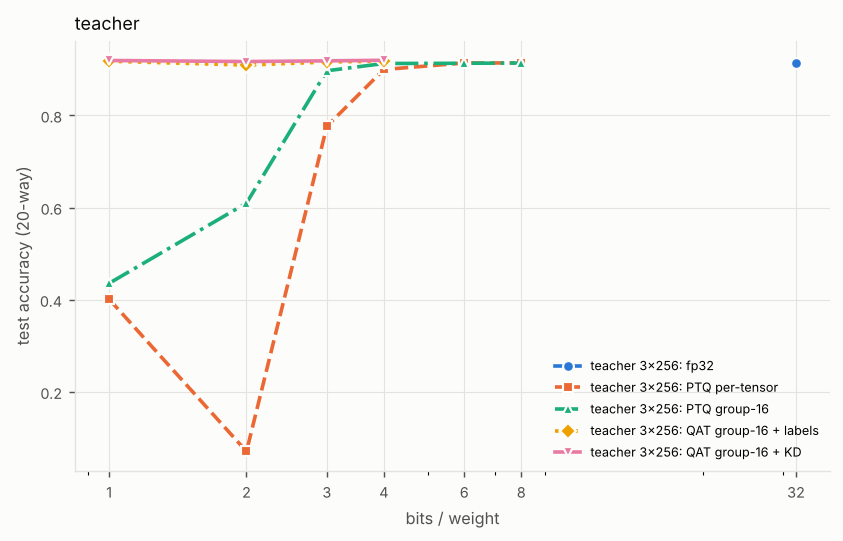
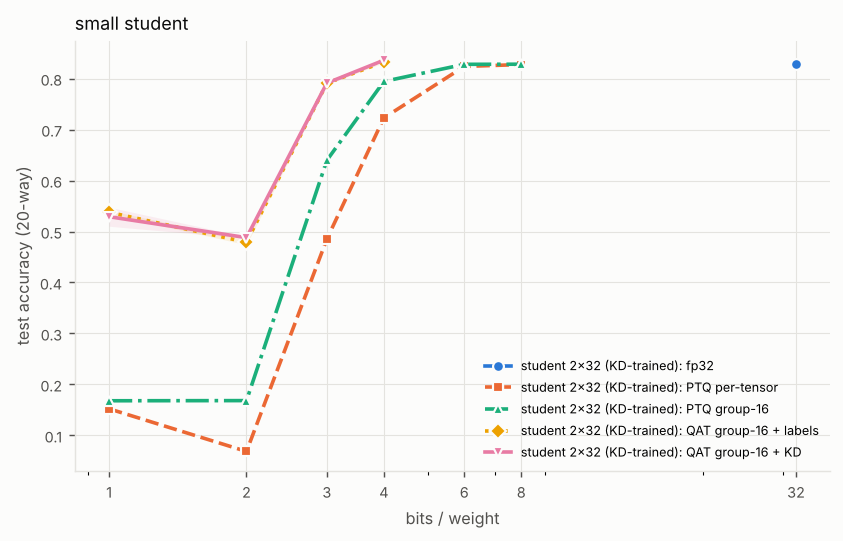
The toy-MLP analogue, not YOLO, is quantization (lab/results/quantization.json), using a NumPy twin of fake_quantize with groups of 16. The table gives 20-class accuracy after rounding, no retraining. In float, the teacher (3x256) scores 0.9139 and the KD-trained student (2x32) 0.8281.
| bits | teacher, per-tensor | teacher, group-16 | student, per-tensor | student, group-16 |
|---|---|---|---|---|
| 8 | 0.914 | 0.9138 | 0.8276 | 0.8282 |
| 6 | 0.9139 | 0.9133 | 0.8238 | 0.828 |
| 4 | 0.8998 | 0.9128 | 0.7229 | 0.7944 |
| 3 | 0.7766 | 0.897 | 0.4851 | 0.6397 |
| 2 | 0.0707 | 0.6098 | 0.0686 | 0.1683 |
8 bits are free, per-group scales extend the range, then a cliff, and the small student breaks first. Training with the rounding in the loop (QAT) plus KD brought the 2-bit teacher back to 0.91705 but the 2-bit student only to 0.488. The toy's cliff sits lower than the detector's, so don't carry the exact bit-width over.
When it breaks
- The real curve (README.md,
carve.py, 125 images, DFL spared): YOLOv8n per-tensor scores 0.4088 at 8 bits, 0.3031 at 6 and 0.0000 at 4, from 0.4284 native; with--group-size 128, 0.4263, 0.3905 and 0.0379. YOLO11n collapses at 6-bit per-tensor (0.0136), where the original "6-bit needs groups" finding came from. - Groups ignore filter boundaries. A 3x3 conv with 16 inputs has 144 values per filter, so a 128-value group can straddle two filters. precision.py's in-channel groups avoid this.
skipis a substring match:"model.2"also matchesmodel.20,model.21andmodel.22, YOLOv8n's head.- The DFL conv (it decodes each box edge from 16 bins) holds fixed weights 0 to 15. Sparing it did not rescue 4-bit: group-128 went from 0.0191 to 0.0379, per-tensor stayed 0.0000 (STATUS.md).
- Uniform INT rounding is the weak scheme. In the precision lab, 4-bit with one scale per output channel kept 16% of native mAP; FP4 levels kept 79%; FP4 with stages 0-2 at 8 bits kept 92% at 4.04 bits per weight; MSE clipping cut FP4 from 79% to 18% (README.md, measured on a VOC-2007 bird stand-in set, so read them as relative).
- Activations stay in float; a real int8 deployment also quantizes them.
- File size doesn't change until you pack the weights. The cockpit's size (weight bits plus 16 bits per scale) is an estimate.
Going further
In the cockpit (uvicorn server:app --port 8000 --app-dir .), the Precision module has "Apply 8-bit", a bits ladder from 16 to 1, the scheme knobs above, a weight microscope, a mixed-precision grid with a fragility scan and Auto-mix, and confession curves. Each change posts the recipe to /api/measure, which scores the real detector on 40 images. Below about 3.5 bits rounding alone can't save it (README.md); Regrow then fine-tunes with the quantizer in the loop (see qat). Headless, python carve.py --group-size 128 sweeps the ladder with fake_quantize. For a real small file, STATUS.md's next step is packing weights and scales, for example as ONNX QDQ. The toy version is lab/compress.py:quantize.
Source code
The exact code the cockpit runs, read from the repository when this page was built.
fake_quantize cockpit/harness/quant.py:27
def fake_quantize(
    w: torch.Tensor,
    bits: int,
    group_size: int | None = None,
) -> torch.Tensor:
    """Return a fake-quantized copy of ``w`` at ``bits`` bits.

    - ``bits >= 16``: returned unchanged (top of the dial / native).
    - ``bits == 1``: binary sign scheme, ``w_hat = sign(w) * mean(|w|)`` per group.
    - ``2..15``: symmetric linear quant with a per-group scale.

    ``group_size`` is the number of consecutive elements (along the flattened
    tensor) that share one scale. ``None`` -> the whole tensor shares one scale.
    Smaller groups = finer scales = less error (but more scale metadata in a
    real format). ``group_size == 1`` is a deliberate no-op.
    """
    if bits < 1:
        raise ValueError("bits must be >= 1")
    if bits >= 16:
        return w.clone()

    orig_shape = w.shape
    orig_dtype = w.dtype
    flat = w.reshape(-1).float()
    n = flat.numel()

    if group_size is None or group_size <= 0 or group_size >= n:
        groups = flat.unsqueeze(0)  # 1 x N: one shared scale
        pad = 0
    else:
        pad = (-n) % group_size
        if pad:
            flat = torch.cat([flat, flat.new_zeros(pad)])
        groups = flat.reshape(-1, group_size)  # G x group_size

    if bits == 1:
        scale = groups.abs().mean(dim=1, keepdim=True).clamp_min(1e-12)
        q = torch.sign(groups)
        q = torch.where(q == 0, torch.ones_like(q), q)  # map exact zeros to +1
        deq = q * scale
    else:
        qmax = _pos_levels(bits)
        scale = groups.abs().amax(dim=1, keepdim=True).clamp_min(1e-12) / qmax
        q = torch.clamp(torch.round(groups / scale), -qmax, qmax)
        deq = q * scale

    out = deq.reshape(-1)
    if pad:
        out = out[:-pad]
    return out.reshape(orig_shape).to(orig_dtype)
apply_uniform cockpit/harness/model.py:57
@torch.no_grad()
def apply_uniform(
    model,
    bits: int,
    group_size: int | None = None,
    skip: tuple[str, ...] = (),
) -> int:
    """Fake-quantize every quantizable weight to ``bits``. Returns how many
    modules were touched. ``skip`` matches on substrings of the module name
    (e.g. ``(".dfl.",)`` to spare the head's fixed DFL bin positions, or
    ``("model.22",)`` to spare the whole YOLOv8n head).
    """
    touched = 0
    for name, mod in iter_weight_modules(model):
        if any(s in name for s in skip):
            continue
        mod.weight.data.copy_(fake_quantize(mod.weight.data, bits, group_size))
        touched += 1
    return touched
fuse cockpit/harness/model.py:28
def fuse(yolo):
    """Fold every BatchNorm into its conv, in place, so edits act on the exact
    weights inference runs. Do this explicitly: newer Ultralytics `predict()`
    fuses a private *copy* and leaves `yolo.model` unfused, so "warm up with a
    predict" no longer fuses anything. Idempotent. Returns `yolo`."""
    if not yolo.model.is_fused():
        yolo.model.fuse(verbose=False)
    return yolo
Simulation figures
Quantization: PTQ vs. QAT, labels vs. KD, big vs. small
How few bits per weight survive? Does a per-group scale rescue low bits, does quantization-aware training rescue more, and do small models tolerate it worse?
This figure did not load: the file is missing or the connection dropped. Reload the page to try again; the experiment's full table on the Results page has the same numbers.
This figure did not load: the file is missing or the connection dropped. Reload the page to try again; the experiment's full table on the Results page has the same numbers.
Full table: Quantization: PTQ vs. QAT, labels vs. KD, big vs. small
Papers
- Nagel et al. A White Paper on Neural Network Quantization (2021)