The idea
Distillation needs inputs to show the teacher, but sometimes the original data is private, lost, or too large to ship. Two fallbacks: feed the teacher random noise and copy whatever it says, or invert the teacher, running gradient descent on the input, with the weights frozen, until the teacher confidently predicts a chosen class. The second produces inputs the teacher "recognizes", built from nothing but its weights.
How it works
Teacher inversion:
- Start with
nrandom inputsX ~ N(0, 1)and assign each a random target classc. - Freeze the teacher. Compute its logits on
Xand the cross-entropy loss againstc. - Backpropagate to the input: get
dLoss/dXinstead of gradients for the weights. - Add a small L2 penalty
l2 · ‖x‖² / 2so the inputs stay near the scale of real data (the real inputs are standardized to mean 0, standard deviation 1 per feature). - Update
Xwith Adam for a fixed number of steps. - Use the final
Xas the transfer set: query the teacher on it and distill with ordinary KD.
Noise baselines skip steps 2-5 and draw X from a Gaussian or a uniform distribution.
X = randn(n, d); c = randint(C, n)
for _ in range(steps):
    g = grad_wrt_input(cross_entropy(teacher(X), c)) + l2 * X / n
    X = adam_step(X, g)
The code, line by line
invert_teacher in lab/experiments/transfer.py:
X = rng.standard_normal((n, t.sizes[0]))starts from noise in the teacher's input dimension (12).c = rng.integers(0, t.sizes[-1], n)andY = np.eye(...)[c]give each input a random one-hot target, so the synthetic set is roughly class-balanced.opt = Adam([X], lr=lr)hands the inputs to the optimizer. The teacher's weights are never in any optimizer, so they cannot change.- Each step,
z, _, cache = t.forward(X, cache=True)runs the teacher and keeps the intermediate values backprop needs. dz = (softmax(z) - Y) / nis the gradient of mean cross-entropy with respect to the logits._, dX = t.backward(cache, dz)backpropagates through the teacher.MLP.backwardinlab/nn.pyreturns weight gradients and, as its second value, the gradient with respect to the input; only the latter is used.opt.step([dX + l2 * X / n])adds the gradient of the L2 prior and movesX.
run_data_free in lab/methods.py builds the transfer inputs for the chosen source: the first n real inputs (8k labeled, then the unlabeled pool), Gaussian noise, uniform noise on [-3, 3], or invert_teacher(t, n, steps=200) wrapped in cached(f"inversion_{n}", ...), so the slow inversion runs once per n and later runs reuse it from disk. It then trains a 2x32 student with FixedSource(X, None, ..., teacher=t) (teacher logits precomputed, no labels) and KD(T=1), and compares it with a student trained on the 8k labels.
What the simulations show
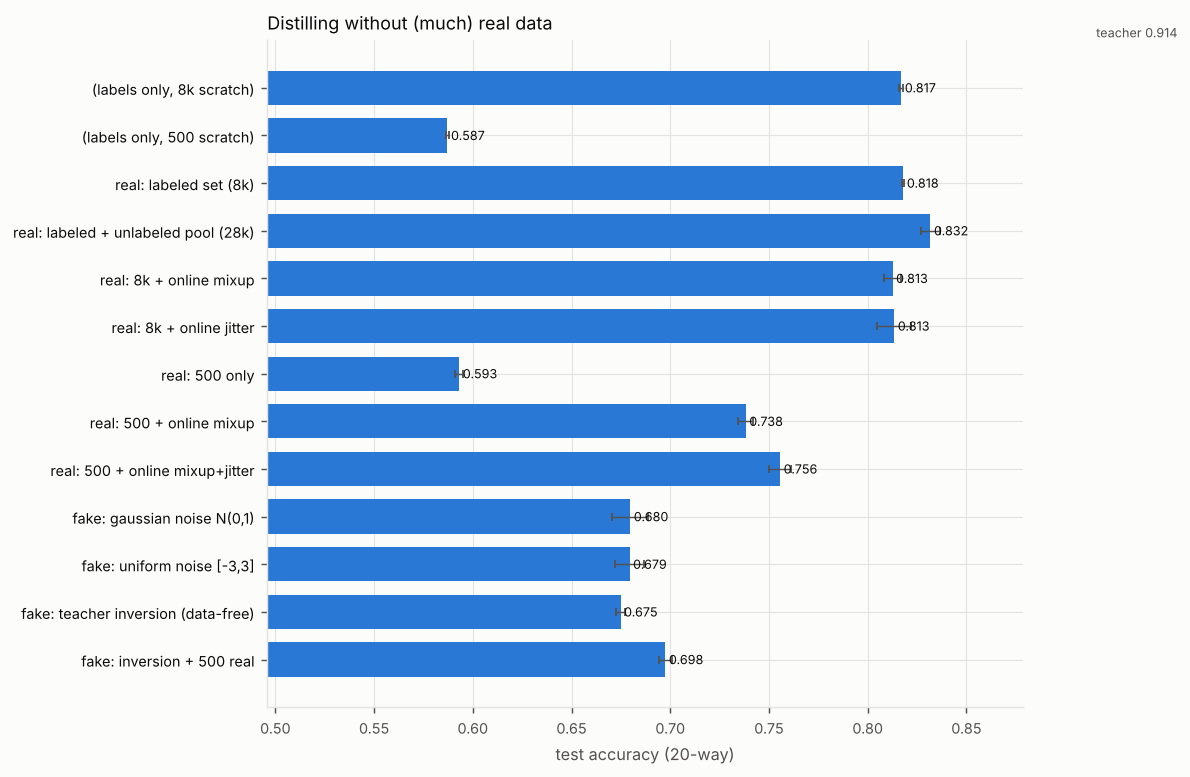
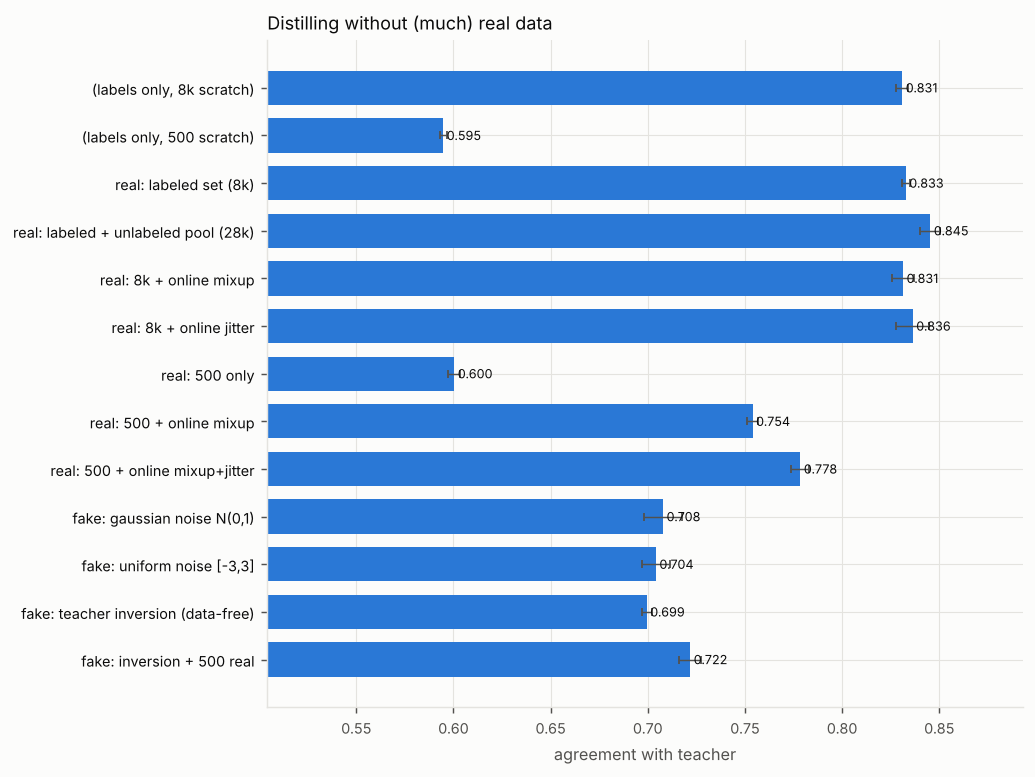
transfer_set (2x32 student, 3 seeds, 3000 steps, KD at T = 1; fidelity is how often the student's top class matches the teacher's):
| transfer inputs | accuracy | fidelity |
|---|---|---|
| labels only, 8k (no teacher) | 0.8170 | 0.8309 |
| real: labeled set (8k) | 0.8180 | 0.8327 |
| real: + unlabeled pool (28k) | 0.8318 | 0.8454 |
| real: 500 only | 0.5931 | 0.6004 |
| fake: gaussian noise N(0,1) | 0.6797 | 0.7078 |
| fake: uniform noise [-3,3] | 0.6794 | 0.7041 |
| fake: teacher inversion | 0.6748 | 0.6994 |
| fake: inversion + 500 real | 0.6975 | 0.7218 |
| labels only, 500 (no teacher) | 0.5872 | 0.5947 |
With no real data, all three fake sources land near 0.68: far below real data, well above the 500 real inputs. Those 500 are training inputs the teacher memorized, so its answers there are nearly their labels (0.5931 against 0.5872 for the labels themselves); noise at least shows the teacher across the whole input space.
Inversion does not beat plain noise. A look at 1000 inverted inputs explains part of it: their mean length is 2.12 against 3.39 for real test inputs (the L2 prior pulls them inward), and the teacher's mean top probability on them is 0.9983, so the targets are nearly one-hot. Gaussian noise already has the same mean length as real inputs (3.39) and the teacher assigns it to all 20 classes.
This page's runs (1000 steps, seed 0, default n = 4000): labels only 0.7398; real 0.7266, Gaussian 0.5733, uniform 0.5559, inversion 0.5788. With n = 500 real inputs the student reached 0.5823, and with all 28000, 0.7455. The first run at a new n is slow; later runs read the cached inversion. The toy flatters noise: 12 standardized numbers are a small space, so random points often land near real data.
When it breaks
- In high-dimensional inputs like images, pure noise covers almost none of the data distribution; the teacher sees only out-of-distribution inputs.
- Inversion with a plain cross-entropy target finds inputs where the teacher is most confident, which are the least informative for distillation.
- Too strong an L2 prior shrinks inputs toward zero; too weak lets them drift far from real data.
- A teacher can be confident on inputs that look nothing like real data, so a high score proves nothing about realism.
Try this
- Set transfer inputs to
gaussian, thenuniform, theninversion, at the same number of inputs. Compare with the labels-only row. - Set transfer inputs to
realand number of inputs to 500, then 4000, then 28000. This shows how much real data the fake sources are worth. - Try
inversionat 1000 inputs to see whether a smaller synthetic set loses much.
Going further
For image classifiers, DeepInversion adds a much stronger prior: it matches the mean and variance of each batch-norm layer to the statistics stored in the teacher, plus image smoothness terms, and produces recognizable images. Later methods train a generator to produce inputs on which teacher and student disagree, so the transfer set targets the student's weak spots. This MLP has no batch-norm, so lab/experiments/transfer.py:invert_teacher is the closest analogue; the DeepInversion reference page covers the rest.
Source code
The exact code that runs, read from the repository when this page was built.
invert_teacher lab/experiments/transfer.py:16
def invert_teacher(t: MLP, n: int, steps: int = 300, lr: float = 0.05, l2: float = 0.05,
                   seed: int = 0) -> np.ndarray:
    """Data-free distillation: synthesize inputs by gradient descent *on the
    input* so the teacher confidently predicts a random class, with an L2
    prior keeping them near the data scale. No real example is used."""
    rng = np.random.default_rng(seed)
    X = rng.standard_normal((n, t.sizes[0])).astype(np.float32)
    c = rng.integers(0, t.sizes[-1], n)
    Y = np.eye(t.sizes[-1], dtype=np.float32)[c]
    opt = Adam([X], lr=lr)
    for _ in range(steps):
        z, _, cache = t.forward(X, cache=True)
        dz = (softmax(z) - Y) / n
        _, dX = t.backward(cache, dz)
        opt.step([dX + l2 * X / n])
    return X
Simulation figures
Distilling without (much) real data
Which inputs carry the teacher's knowledge best: real labeled, real unlabeled, augmented, pure noise, or inputs dreamed up by inverting the teacher?
This figure did not load: the file is missing or the connection dropped. Reload the page to try again; the experiment's full table on the Results page has the same numbers.
This figure did not load: the file is missing or the connection dropped. Reload the page to try again; the experiment's full table on the Results page has the same numbers.
Papers
- Lopes et al. Data-Free Knowledge Distillation for Deep Neural Networks (2017)
- Yin et al. Dreaming to Distill (DeepInversion) (2020)