The idea
Output distillation tells the student what the teacher answered. Its hidden layers also hold how: an internal representation of the input. FitNets adds a loss that makes a student hidden layer predict a teacher hidden layer. Similarity-preserving KD (SP) asks for less: inside each batch, examples the teacher represents as similar should look similar to the student too. SP never compares features directly, so the two networks can have any widths.
How it works
FitNets hint, for a batch of N inputs:
- Run teacher and student; take student hidden activations
hs(shapeN × ds) and teacher activationsht(shapeN × dt). Hidden activations are a layer's outputs after its ReLU. - Map the student to teacher width with a trainable matrix
P(ds × dt), since the widths differ. - Loss:
mean((hs · P − ht)²). TrainPand the student together.
Similarity-preserving, for the same batch:
- Build each network's Gram matrix, the table of dot products between every pair of examples:
A = h · hᵀ(N × N). - Divide each row by its length:
G = A / ‖A_row‖. - Loss:
Σ (Gs − Gt)² / N².
Both are added to the KD loss with a weight, and both need the teacher's hidden activations.
The code, line by line
Hint.__init__ in lab/train.py stores which student layer (s_layer) and teacher layer (t_layer) to align and creates self.P, a random d_s × d_t matrix scaled by 1 / sqrt(d_s). Its params() returns [self.P], so fit adds P to the optimizer (extra = [p for t in terms for p in t.params()]).
Hint.__call__: hs, ht = hid[self.s], b.t_hidden[self.t] picks the two layers; b.t_hidden exists because distill passes hidden=bool(extra_terms) to FixedSource. r = hs @ self.P - ht is the residual, n = r.size. The gradient for P is self.dP = self.w * hs.T @ (2 * r / n), and the gradient flowing into the student's hidden layer is dh = self.w * (2 * r / n) @ self.P.T. It returns np.zeros_like(z) for the logits and {self.s: dh}. In lab/nn.py, MLP.backward adds dhid[i - 1] when it reaches layer i, which injects dh exactly at hidden layer s. fit appends t.dP to the gradients in the same order it added P to the optimizer.
SP._gram(h) returns A = h @ h.T, the row norms nrm, and A / nrm. SP.__call__ builds Gs and Gt, then loss = ((Gs - Gt) ** 2).sum() / (N * N). dG = 2 * (Gs - Gt) / (N * N) is the gradient with respect to Gs. dA = (dG - Gs * (Gs * dG).sum(1, keepdims=True)) / nrm pushes it back through the row normalization: the subtracted term removes the part of dG that only changes a row's length, which normalization would undo anyway. Since A = h hᵀ uses h twice, dh = (dA + dA.T) @ hs.
run_feature_kd in lab/methods.py distills at distill's default T = 1 and uses Hint(1, 2, w, 256, ...) or SP(1, 2, ...): student layer 1 (the last of its two hidden layers) against teacher layer 2 (the last of its three 256-wide layers). It trains labels only, KD, and KD plus your term.
What the simulations show
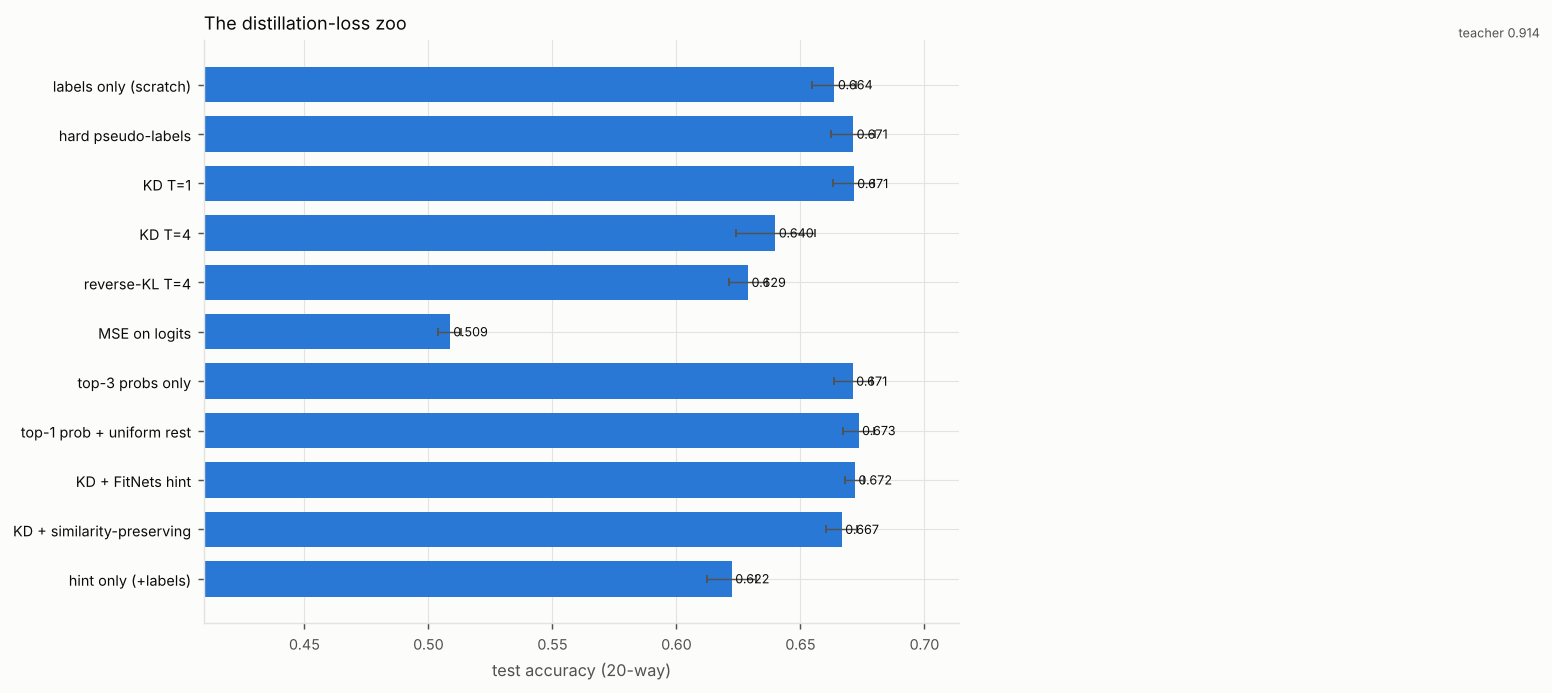
loss_zoo (2x16 student, 3 seeds, 3000 steps, KD at T = 1; hint weight 0.05, SP weight 50):
| arm | accuracy |
|---|---|
| labels only | 0.6637 |
| KD T=1 | 0.6714 |
| KD + FitNets hint | 0.6719 |
| KD + similarity-preserving | 0.6666 |
| hint only (+labels) | 0.6223 |
Neither term adds to plain KD beyond seed noise (standard deviations here are 0.004-0.010), and a hint with labels but no KD is worse than labels alone. This page's runs (1000 steps, seed 0, width 16) agree: KD 0.5850; KD + SP at weight 50 gave 0.5800, at weight 1 gave 0.5846; KD + hint at weight 0.05 gave 0.5892, at weight 5 gave 0.5092.
Likely reason: forcing 16 student units to linearly predict 256 teacher units uses capacity the student needs for the task. The toy also lacks what makes these methods work on images: spatial feature maps, where "which region is active" is a cheap, transferable signal.
When it breaks
- The loss weight must be tuned to the term's natural scale: here a hint works around 0.05 and SP around 50 (the page default).
- Too large a hint weight crowds out the task (0.5092 at weight 5 above).
- Which layers to pair is a guess; a hint at the wrong depth can fight the student's own solution.
- SP depends on the batch: small batches give a poor Gram matrix, and cost grows as
N².
Try this
- Keep extra loss at
spand compare loss weight 50 (the scale used inloss_zoo) with 1 and 100. - Set extra loss to
hintand sweep loss weight over 0.05, 0.5 and 5. Watch for the point where accuracy drops below plain KD. - Raise student width to 64 with
hint; a wider student has capacity to spare.
Going further
On convolutional networks, FitNets matches feature maps through a 1x1 convolution (the analogue of P), and attention transfer matches spatial activation maps. For detectors, feature distillation is usually restricted to regions near objects, since most of an image is background. In transformers, distilling attention maps and hidden states layer by layer is common for compressing language models. lab/train.py:Hint and lab/train.py:SP are the closest analogues here; MLP.backward's dhid argument is how any such term plugs into training without autograd.
Source code
The exact code that runs, read from the repository when this page was built.
Hint lab/train.py:229
class Hint:
    """FitNets: regress a student hidden layer onto a teacher hidden layer
    through a learned linear projection (student width -> teacher width)."""

    def __init__(self, s_layer: int, t_layer: int, d_s: int, d_t: int, weight: float = 1.0,
                 seed: int = 0):
        rng = np.random.default_rng(seed)
        self.s, self.t, self.w = s_layer, t_layer, weight
        self.P = (rng.standard_normal((d_s, d_t)) / np.sqrt(d_s)).astype(F)
        self.dP = np.zeros_like(self.P)

    def params(self):
        return [self.P]

    def __call__(self, z, hid, b: Batch):
        hs, ht = hid[self.s], b.t_hidden[self.t]
        r = hs @ self.P - ht
        n = r.size
        self.dP = self.w * hs.T @ (2 * r / n)
        dh = self.w * (2 * r / n) @ self.P.T
        return self.w * (r ** 2).mean(), np.zeros_like(z), {self.s: dh}
SP lab/train.py:252
class SP:
    """Similarity-preserving KD (Tung & Mori): match the batch's pairwise
    similarity structure, not the features themselves. Width-agnostic."""

    def __init__(self, s_layer: int, t_layer: int, weight: float = 1.0):
        self.s, self.t, self.w = s_layer, t_layer, weight

    @staticmethod
    def _gram(h):
        A = h @ h.T
        nrm = np.sqrt((A ** 2).sum(1, keepdims=True)) + 1e-8
        return A, nrm, A / nrm

    def __call__(self, z, hid, b: Batch):
        hs, ht = hid[self.s], b.t_hidden[self.t]
        N = len(hs)
        A, nrm, Gs = self._gram(hs)
        _, _, Gt = self._gram(ht)
        dG = 2 * (Gs - Gt) / (N * N)
        dA = (dG - Gs * (Gs * dG).sum(1, keepdims=True)) / nrm
        dh = (dA + dA.T) @ hs
        loss = ((Gs - Gt) ** 2).sum() / (N * N)
        return self.w * loss, np.zeros_like(z), {self.s: self.w * dh}

    params = staticmethod(lambda: [])
Simulation figures
The distillation-loss zoo
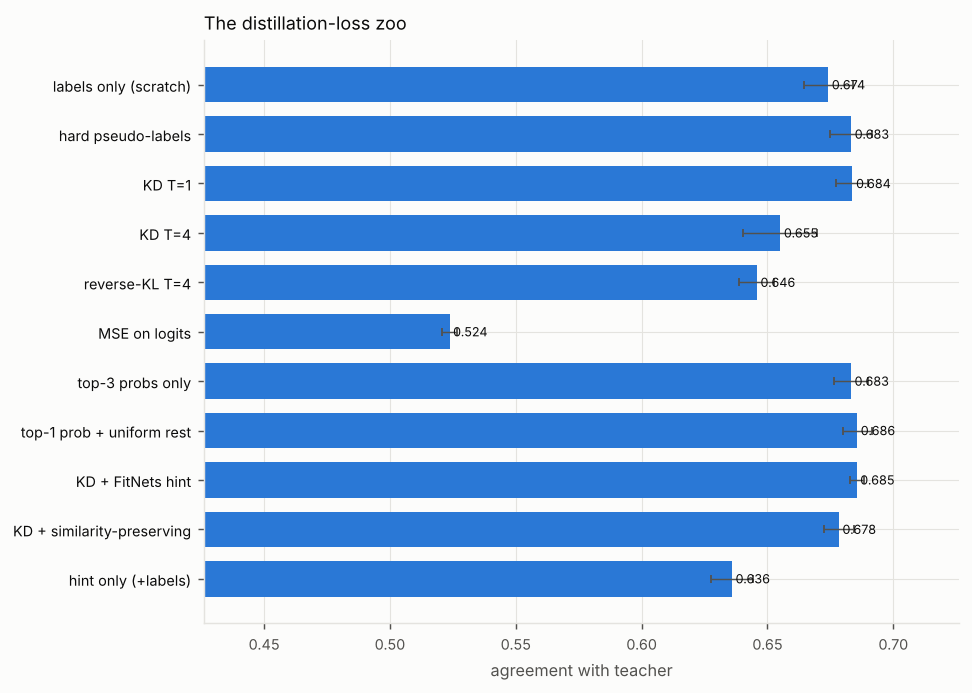
Same student, same teacher, same inputs: which form of teacher signal transfers the most? (logits, probabilities, top-k only, hard labels, hidden features, relational structure)
This figure did not load: the file is missing or the connection dropped. Reload the page to try again; the experiment's full table on the Results page has the same numbers.
This figure did not load: the file is missing or the connection dropped. Reload the page to try again; the experiment's full table on the Results page has the same numbers.
Papers
- Romero et al. FitNets: Hints for Thin Deep Nets (2015)
- Tung & Mori. Similarity-Preserving Knowledge Distillation (2019)