The idea
Hinton KD is one way to compare student and teacher outputs. The variants change what the student is punished for (reverse KL), skip probabilities (logit MSE), keep only the top answer (hard pseudo-labels), or model an API that reveals only top-k probabilities. Each keeps a different part of the signal.
How it works
Let pt = softmax(zt / T) and ps = softmax(zs / T) be the teacher's and student's tempered probabilities (logits are raw scores; temperature T flattens the probabilities).
- Forward KL (
kl):T² · Σ pt · (log pt − log ps). Punishes missing mass where the teacher has some, so the student covers every plausible class ("mode-covering"). - Reverse KL (
rkl):T² · Σ ps · (log ps − log pt). Punishes mass the teacher lacks, so a weak student commits to the main answer ("mode-seeking"). - Logit MSE (
mse):mean((zs − zt)²). No softmax, no temperature. Hinton showed KD approaches this asTgrows, if logits are zero-mean. - Hard (
hard): replaceptby a one-hot vector at the teacher's top class and use cross-entropy. No information about other classes. - Top-k (
topk): take the teacher'sklargest probabilities atT = 1(what an API would return), spread the remaining mass evenly over the other classes, then soften the result withTand apply forward KL.
The code, line by line
KD._teacher_probs in lab/train.py builds the target; hard ignores temperature. For topk it starts from p = softmax(tl) at T = 1; thr = -np.sort(-p, 1)[:, self.k - 1:self.k] is each row's k-th largest probability, keep = p >= thr marks the top k, and rest = (1 - (p * keep).sum(1, keepdims=True)) / (~keep).sum(1, keepdims=True).clip(1) is the leftover mass shared evenly, assembled by np.where(keep, p, np.maximum(rest, 1e-12)). Only then comes temperature: p = p ** (1 / T), renormalized, which equals softmax(log p / T). Other kinds use p = softmax(tl, T). A group matrix G sums classes into a coarser label space (p @ self.G). For hard, onehot(p.argmax(1), ...) keeps the top class.
KD.__call__ returns the loss and its gradient with respect to the student logits z.
mseis handled first:r = z - t, loss(r ** 2).mean(), gradient2 * r / r.size..mean()divides by rows times classes; the KL terms divide by rows only.hard:loss = -(pt * log_softmax(z)).sum() / N, gradient(softmax(z) - pt) / N, the cross-entropy gradient.rkl:per = (ps * (ls - lt)).sum(1, keepdims=True)is the per-row reverse KL; differentiating through the softmax givesdz = T * ps * (ls - lt - per) / N.klandtopkshare the forward-KL branch:loss = T * T * (pt * (lt - ls)).sum() / N,dz = T * (ps - pt) / N. Forkl,lt = log_softmax(b.t_logits, T)is exact; otherwisenp.log(pt + 1e-12).
run_kd_losses in lab/methods.py trains three students through distill on the 28k inputs: labels only, forward KL at your temperature, and your kind.
What the simulations show
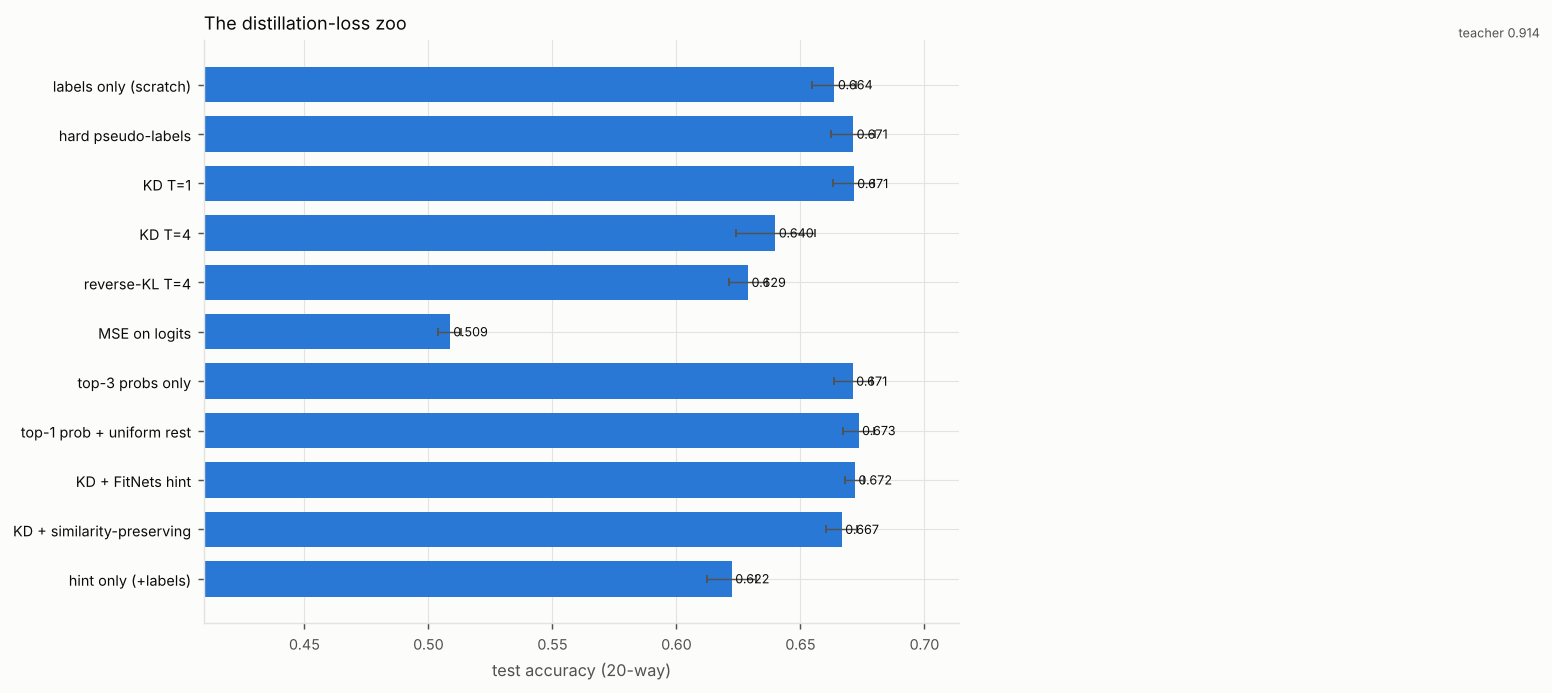
loss_zoo (2x16 student, 3 seeds, 3000 steps, same inputs for every arm; T = 1 unless named):
| loss | accuracy | NLL |
|---|---|---|
| labels only | 0.6637 | 1.0180 |
| hard pseudo-labels | 0.6712 | 0.9925 |
| KD T=1 | 0.6714 | 0.9909 |
| KD T=4 | 0.6398 | 1.8185 |
| reverse-KL T=4 | 0.6288 | 3.4385 |
| MSE on logits | 0.5086 | 2.6093 |
| top-3 probs only | 0.6710 | 0.9897 |
| top-1 prob + uniform rest | 0.6734 | 0.9957 |
NLL is the mean negative log-probability of the true class. Hard pseudo-labels and T = 1 KD nearly coincide: this teacher's T = 1 outputs are close to one-hot (mean top probability 0.9684 on unlabeled inputs). MSE is far worst: the teacher's logits span a median of 47.2 units, a scale a 2x16 network wastes capacity chasing. At T = 1, top-3 and even top-1 plus a uniform rest match full KD, so almost nothing the student uses lives in the tail. Temperature hurts: KD and reverse KL at T = 4 fall below labels only.
This page's runs (1000 steps, seed 0, width 16, page default T = 4): labels only 0.5803, forward KL 0.5551, reverse KL 0.5309, MSE 0.4134, hard 0.5838, top-1 0.5373, top-3 0.5525. At temperature 1, forward KL gave 0.5850. A toy teacher this confident cannot show where the tail matters most, such as language models with thousands of plausible next tokens.
When it breaks
mseis not shift-invariant: a constant added to every logit changes the loss but not the probabilities, so the student must match a meaningless offset.rklwith a small student locks onto the top class and is badly calibrated (NLL 3.4385 above).topkguesses that the hidden mass is spread evenly. At highTthat guess becomes a large, flat part of the target that the real teacher never expressed.topkkeeps more than k classes when probabilities tie, becausekeep = p >= thr.
Try this
- Set loss to
hardand temperature to 1 (the forward-KL row follows). They should nearly coincide. - Set loss to
topkand temperature to 1, then sweep k (for topk) from 1 to 10. Find where accuracy stops changing; repeat at temperature 4. - Set loss to
rkland student width to 64; a larger student can follow more than one mode.
Going further
For language models, with tens of thousands of classes per token, MiniLLM argues for reverse KL so a small student commits to high-probability continuations. Hosted models often expose only top-k log-probabilities, which topk imitates. The grouping matrix in _teacher_probs is this repo's analogue of distilling a detector into a one-class specialist.
Source code
The exact code that runs, read from the repository when this page was built.
KD._teacher_probs lab/train.py:181
    def _teacher_probs(self, tl):
        T = 1.0 if self.kind == "hard" else self.T
        if self.kind == "topk":
            # An API reveals the top-k probabilities at T=1 and nothing else.
            # Spread the unknown remainder uniformly, *then* apply temperature.
            p = softmax(tl)
            thr = -np.sort(-p, 1)[:, self.k - 1:self.k]
            keep = p >= thr
            rest = (1 - (p * keep).sum(1, keepdims=True)) / (~keep).sum(1, keepdims=True).clip(1)
            p = np.where(keep, p, np.maximum(rest, 1e-12))
            if T != 1:
                p = p ** (1 / T)
                p = p / p.sum(1, keepdims=True)
        else:
            p = softmax(tl, T)
        if self.G is not None:
            p = p @ self.G
        if self.kind == "hard":
            p = onehot(p.argmax(1), p.shape[1])
        return p.astype(F)
KD.__call__ lab/train.py:202
    def __call__(self, z, hid, b: Batch):
        N, T = len(z), self.T
        if self.kind == "mse":
            t = b.t_logits if self.G is None else np.log(softmax(b.t_logits) @ self.G + 1e-8)
            r = z - t
            return self.w * (r ** 2).mean(), self.w * 2 * r / r.size, {}
        pt = self._teacher_probs(b.t_logits)
        if self.kind == "hard":
            loss = -(pt * log_softmax(z)).sum() / N
            return self.w * loss, self.w * (softmax(z) - pt) / N, {}
        ls = log_softmax(z, T)
        ps = np.exp(ls)
        # exact teacher log-probs when we can (log(p + eps) distorts tiny probabilities)
        lt = log_softmax(b.t_logits, T) if self.kind == "kl" and self.G is None \
            else np.log(pt + 1e-12)
        if self.kind == "rkl":
            per = (ps * (ls - lt)).sum(1, keepdims=True)
            loss = T * T * per.sum() / N
            dz = T * ps * (ls - lt - per) / N
        else:  # kl / topk
            loss = T * T * (pt * (lt - ls)).sum() / N
            dz = T * (ps - pt) / N
        return self.w * loss, self.w * dz, {}
Simulation figures
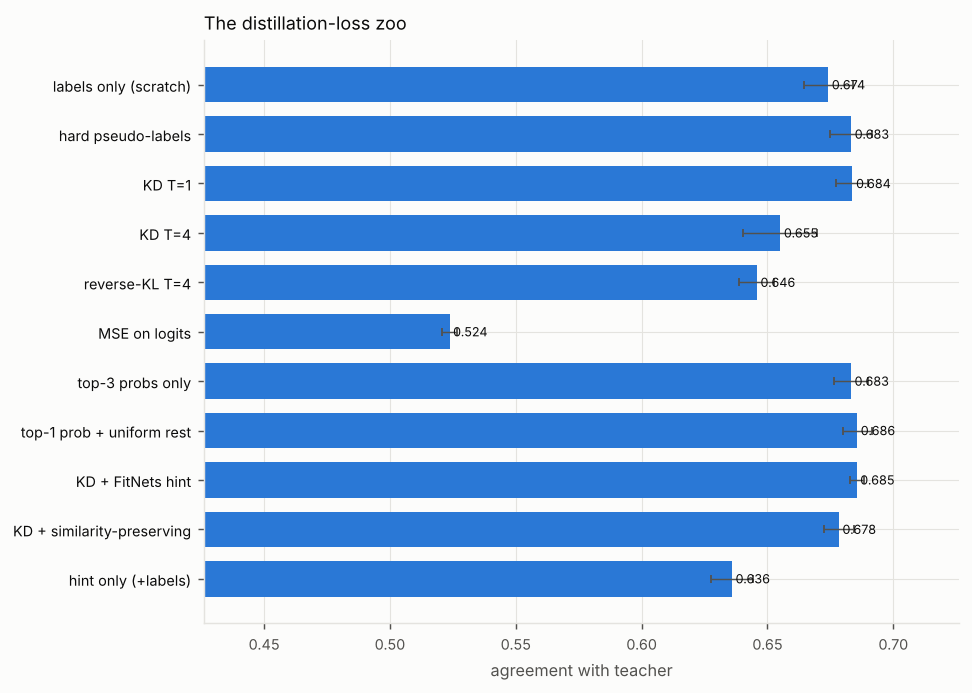
The distillation-loss zoo
Same student, same teacher, same inputs: which form of teacher signal transfers the most? (logits, probabilities, top-k only, hard labels, hidden features, relational structure)
This figure did not load: the file is missing or the connection dropped. Reload the page to try again; the experiment's full table on the Results page has the same numbers.
This figure did not load: the file is missing or the connection dropped. Reload the page to try again; the experiment's full table on the Results page has the same numbers.
Papers
- Kim et al. Comparing Kullback-Leibler Divergence and Mean Squared Error Loss in Knowledge Distillation (2021)
- Gu et al. MiniLLM: Knowledge Distillation of Large Language Models (2023)