The idea
Many weights in a trained network are close to zero. Magnitude pruning treats |w| as a stand-in for importance and sets the smallest weights to exactly zero. This is unstructured pruning: the matrix keeps its shape but becomes sparse (mostly zeros). A recovery phase (more training with removed weights held at zero) wins back most of the lost accuracy.
How it works
- Pick a sparsity
s, the fraction of all weights to remove (0.9 keeps 1 in 10). - Rank weights by
|w|. A global ranking puts every layer in one list. A per-layer ranking removes the same fraction from each layer. - Let
k = s * n_weights. The thresholdthris thek-th smallest|w|. The mask ism = (|w| > thr), a 0/1 array shaped likeW. - Use
W * mfrom now on, and multiply the gradient bymtoo, so dead weights stay dead. - Recover with labels or knowledge distillation (KD), where the pruned net learns to match the unpruned net's output probabilities.
- Gradual variant: repeat steps 2-5 with a rising
s.
mags = concat(|W_i| for every layer)          # already-pruned weights count as 0
thr = kth_smallest(mags, int(s * len(mags)))
for i in layers:
    W_i = W_i * (|W_i| > thr)
The code, line by line
magnitude_prune in lab/compress.py starts with net = net.copy(), so the input is never modified.
The helper mask_for(mags, flat) does the ranking. k = int(round(sparsity * flat.size)) counts how many weights must be zero, over all weights, already-pruned ones included. thr = np.partition(flat, k - 1)[k - 1] finds the k-th smallest magnitude without a full sort, and the mask is mags > thr. Dead weights have magnitude 0, sit at the bottom and stay dead. So calling the function again with a higher target removes only the difference.
In the global branch, flat = np.concatenate([np.abs(net.eff(i)).ravel() for i in layers]) pools every layer's magnitudes, so one threshold applies everywhere. net.eff(i) is the weight as the forward pass uses it. The per-layer branch calls mask_for(w, w.ravel()) once per layer.
net.apply_masks() writes the zeros in (self.W[i] *= m in lab/nn.py). MLP.eff multiplies by the mask on every forward pass, MLP.backward does dW[i] *= self.masks[i], and fit re-applies masks after each optimizer step, so dead weights stay dead.
run_magnitude in lab/methods.py calls magnitude_prune(m, 1 - (1 - sp) ** (i / k)) for gradual step i of k. That is a geometric schedule: each step removes the same share of the survivors. For sp = 0.9, k = 5 the targets are about 0.37, 0.60, 0.75, 0.84 and 0.90. Each step is followed by scratch (labels) or distill (KD from the unpruned teacher) for FT // k steps, so the total recovery budget is fixed.
What the simulations show
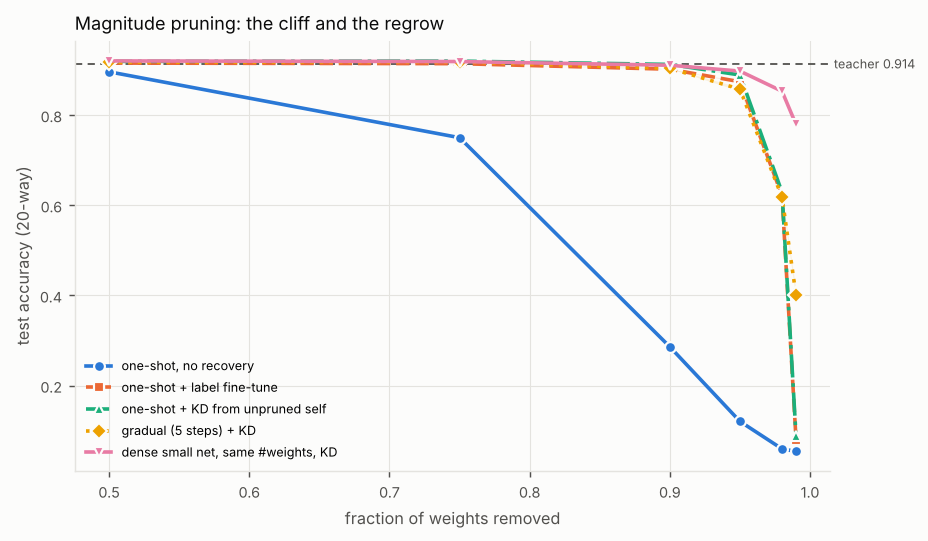
The teacher is a 3x256 MLP: 140,052 parameters, 0.9139 accuracy on 20 classes, 0.9885 average precision (AP) on class 0, the "bird". AP is the same kind of single-class ranking score as the YOLOv8n cockpit's bird mAP@50. From prune_unstructured (accuracy; 1,500 recovery steps; mean of 2 seeds):
| sparsity | no recovery | + labels | + KD from unpruned self | gradual (5 steps) + KD | dense net, same weight count, KD |
|---|---|---|---|---|---|
| 0.5 | 0.8961 | 0.9154 | 0.9193 | 0.9173 | 0.9203 |
| 0.75 | 0.7500 | 0.9142 | 0.9199 | 0.9183 | 0.9188 |
| 0.9 | 0.2860 | 0.9019 | 0.9125 | 0.9038 | 0.9107 |
| 0.95 | 0.1206 | 0.8741 | 0.8891 | 0.8576 | 0.8977 |
| 0.98 | 0.0597 | 0.6215 | 0.6289 | 0.6179 | 0.8531 |
| 0.99 | 0.0540 | 0.0804 | 0.0883 | 0.4007 | 0.7792 |
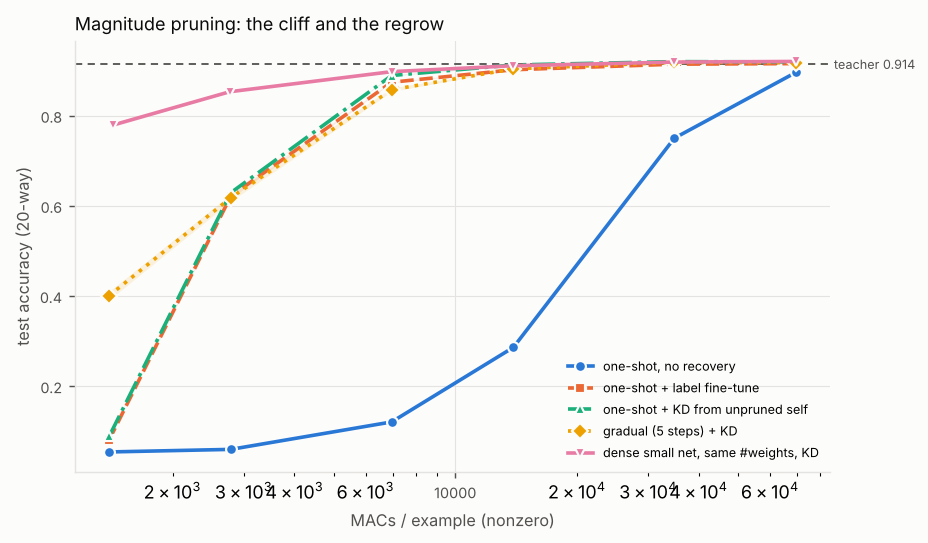
Without recovery there is a cliff between 75% and 90%, the shape the cockpit saw for channel cuts on YOLOv8n. KD recovery brings 90% sparsity back to 0.9125. At 50-75% it ends slightly above the teacher, because recovery is also extra training on 28,000 inputs. KD beats labels at every sparsity. Gradual pruning is a little worse than one-shot up to 98%, but at 99% it is the only sparse arm that survives (0.4007 against 0.0883). From 95% up, a small dense net with the same weight count beats every sparse one.
Page runs (500 recovery steps): the defaults (0.9, KD, global) recover from 0.2785 to 0.8965, and labels reach 0.8898. Per-layer ranking starts at 0.1326 and recovers to 0.8603. Five gradual steps reach 0.8613 at 0.9 and 0.7256 at 0.95, below one-shot (0.8965, 0.8212), because each recovery gets only 100 steps.
When it breaks
- Sparse is not small or fast by itself. Savings need a sparse storage format, sparse kernels, or hardware patterns such as 2:4.
- Per-layer ranking cuts the small input and output layers as hard as the big hidden ones.
- Fraction of what? If a pruning function ranks only surviving weights, repeated calls with rising total targets compound. An earlier version of this function did that: its 5-step "0.9" schedule ended at 99.9%. Check the nonzero count.
- Past the cliff whole neurons lose every input or output weight, and one-shot recovery has nothing left to retrain.
- Magnitude is a proxy. A small weight on a large activation can matter more than a large one on a near-zero input.
Try this
- Compare recovery none and kd at fraction removed 0.75, then 0.95.
- Set gradual steps to 5 at 0.9 and at 0.95, and compare with 1 step. The budget is fixed, so more steps means shorter recoveries.
- Switch ranking between global and per-layer at 0.9 and compare the unrecovered rows.
- Compare recovery labels and kd at 0.9.
Going further
On large models unstructured sparsity pays off only with a runtime that exploits it, such as sparse formats on CPUs or N:M patterns on recent GPUs. See also Wanda and SparseGPT. The YOLOv8n cockpit does not prune single weights. It zeros whole channels (harness/mask.py masks the lowest-L1 output channels of a stage), because a channel can actually be removed from a conv layer. The cliff-then-recover pattern is the lesson the cockpit's README draws: the loop must be prune → fine-tune → test, never prune → test.
Source code
The exact code that runs, read from the repository when this page was built.
magnitude_prune lab/compress.py:82
def magnitude_prune(net: MLP, sparsity: float, global_: bool = True,
                    spare_last: bool = False) -> MLP:
    """Zero the smallest-|w| weights until ``sparsity`` of *all* weights (not of
    the ones still alive) are zero, so calling it repeatedly with a rising
    target (gradual pruning, lottery-ticket rounds) does not compound.
    ``global_`` ranks across all layers (lets big redundant layers absorb more
    of the cut); otherwise each layer gets the same sparsity."""
    net = net.copy()
    layers = [i for i in range(net.n_layers) if not (spare_last and i == net.n_layers - 1)]

    def mask_for(mags: np.ndarray, flat: np.ndarray) -> np.ndarray:
        k = int(round(sparsity * flat.size))
        if k == 0:
            return mags != 0 if (flat == 0).any() else np.ones_like(mags, bool)
        thr = np.partition(flat, k - 1)[k - 1]
        return mags > thr

    if global_:
        flat = np.concatenate([np.abs(net.eff(i)).ravel() for i in layers])
        for i in layers:
            net.masks[i] = mask_for(np.abs(net.eff(i)), flat).astype(F)
    else:
        for i in layers:
            w = np.abs(net.eff(i))
            net.masks[i] = mask_for(w, w.ravel()).astype(F)
    net.apply_masks()
    return net
MLP.apply_masks lab/nn.py:186
    def apply_masks(self) -> None:
        for i, m in enumerate(self.masks):
            if m is not None:
                self.W[i] *= m
Simulation figures
Magnitude pruning: the cliff and the regrow
How sparse can the teacher get? Compare one-shot cuts with and without recovery, recovery by labels vs. by distilling from the unpruned self, gradual pruning, and a dense small model with the same weight count.
This figure did not load: the file is missing or the connection dropped. Reload the page to try again; the experiment's full table on the Results page has the same numbers.
This figure did not load: the file is missing or the connection dropped. Reload the page to try again; the experiment's full table on the Results page has the same numbers.
Papers
- Han et al. Learning both Weights and Connections for Efficient Neural Networks (2015)
- Zhu & Gupta. To prune, or not to prune (2017)