The idea
A small network is hard to train well. Gradient descent on few parameters gets stuck more easily than on many. The trick is to train a bigger network that is secretly the same small one. Write each weight matrix as a product of two matrices with a wide linear layer between them, W = W1 W2. A product of linear maps is still one linear map, so after training you multiply the factors back together and get a network of exactly the original shape. The expanded version can express nothing new. What changes is how gradient descent moves through the weights.
How it works
- Take the target architecture, say 12 → 16 → 16 → 20.
- Replace every layer
a → bby two:a → E → bwithE = expand * max(a, b), and no activation after the first (a linear layer). - Train this expanded network normally.
- Collapse each pair:
(h W1 + b1) W2 + b2 = h (W1 W2) + (b1 W2 + b2). The new weight isW1 @ W2and the new bias isb1 @ W2 + b2. - Deploy the collapsed network. Its outputs are identical to the trained expanded one, up to float rounding.
The code, line by line
overparam in lab/experiments/small.py builds the expanded shape. base = [d.world.spec.d] + list(hidden) + [d.world.C] is the target, for example [12, 16, 16, 20]. For each target layer i, lin.add(len(sizes) - 1) marks the index of the layer about to be added as linear, and sizes += [expand * max(base[i], base[i + 1]), base[i + 1]] appends the wide middle and then the real output. With width 16 and expansion 4 the sizes are [12, 64, 16, 64, 16, 80, 20], which is 6,980 parameters instead of 820. Every layer is expanded, input and output included. MLP(sizes, seed=seed, linear=lin) creates it, and in MLP.forward a = z if self.lin[i] else np.maximum(z, 0) skips the ReLU on the marked layers.
MLP.collapse_linear in lab/nn.py works on a copy. It walks the layers with i and, whenever net.lin[i] is true, merges layer i into layer i + 1. It first asserts the layer is not residual and has no masks, because neither survives the algebra. net.b[i + 1] = net.b[i] @ W2 + net.b[i + 1] pushes the first bias through the second matrix. net.W[i + 1] = net.W[i] @ W2 is the merged weight. Layer i is then deleted from every per-layer list and del net.sizes[i + 1] drops the wide middle width. i is not advanced, so the merged (now nonlinear) layer is checked once more and skipped.
run_overparam in lab/methods.py trains the plain 2xW net and the expanded net for the same 1,000 steps. It reports the expanded and the collapsed net with their true sizes from n_params(False).
What the simulations show
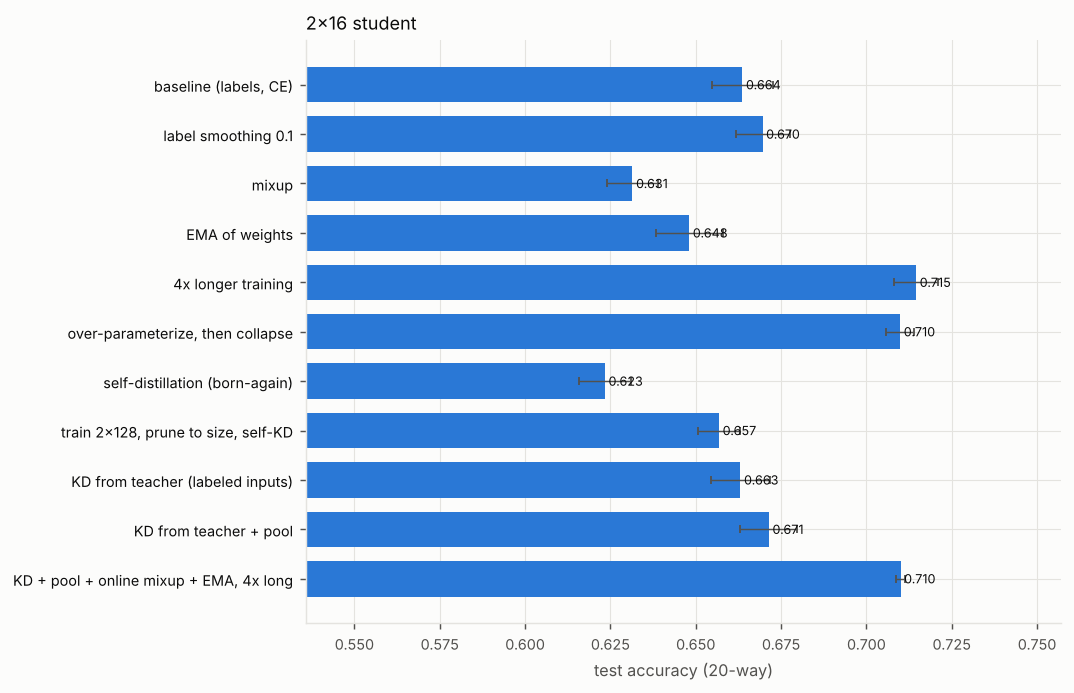
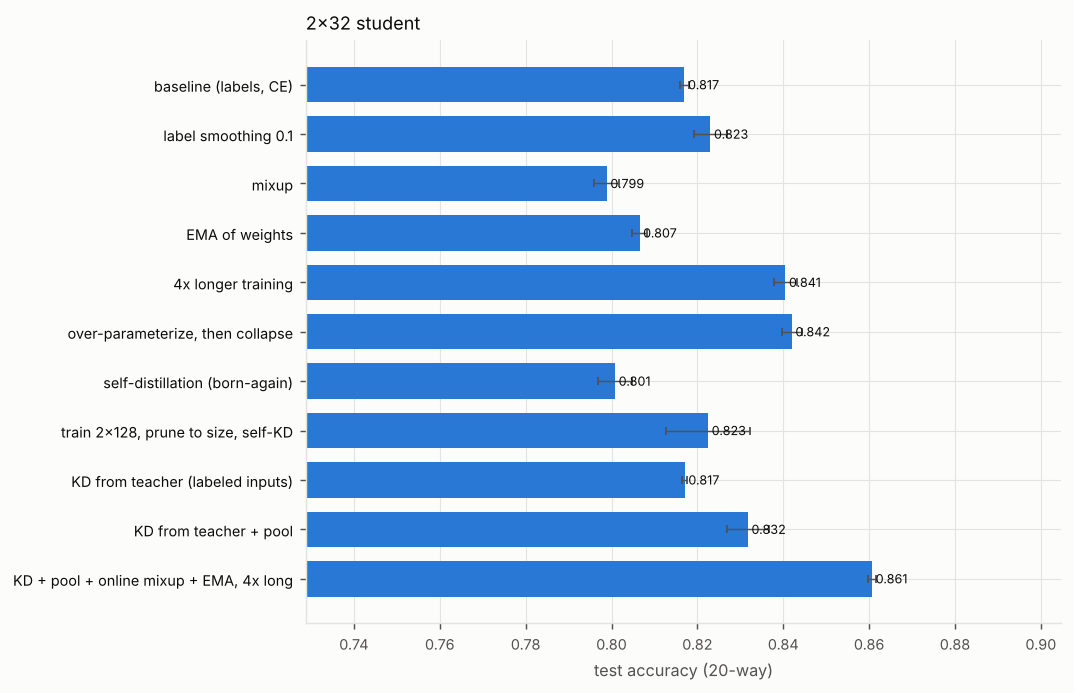
From small_tricks, with 3,000 training steps and 3 seeds (accuracy on 20 classes; the teacher reaches 0.9139):
| student | plain (labels) | over-parameterize, then collapse | 4x longer training |
|---|---|---|---|
| 2x16 (820 params) | 0.6637 | 0.7099 | 0.7146 |
| 2x32 (2,132 params) | 0.8170 | 0.8420 | 0.8405 |
The collapsed network gains as much as training 4 times longer, at no inference cost. Training is costlier: each step of the expanded 2x16 net touches 6,980 parameters instead of 820.
Page runs (1,000 steps): at width 16 and expansion 4, plain gets 0.5803 and the collapsed net 0.6589. The expanded and collapsed rows match exactly. With expansion 1 (a product of two matrices with no extra width) the collapsed net gets 0.5766, no better than plain. The extra width, not the factorization, is what helps. At width 32: plain 0.7398, collapsed 0.8253.
The toy doesn't separate why it helps. Candidate reasons include the implicit momentum-like acceleration Arora et al. describe, the different effective initialization of a product of two random matrices, and weight decay acting on the factors rather than on their product.
When it breaks
- Nonlinearities in between. Collapsing is exact only if nothing nonlinear sits between the factors: no ReLU, no dropout. Batch-norm can be folded first (see Batch-norm folding).
- Masks and residuals.
collapse_linearasserts against them. A pruning mask on a factor does not become a mask on the product. - No extra width, no gain. Expansion 1 reproduced the plain result.
- Capacity is unchanged. It helps optimization, not expressiveness.
Try this
- At width 16, step expansion factor through 1, 2, 4 and 8. Look for where the gain over "plain" stops growing.
- Compare width 16 and 32 at expansion factor 4. In the page run the gain over plain was 0.0786 at width 16 and 0.0855 at width 32. Check whether it keeps growing at 64.
- Check the "trained expanded" and "collapsed back" rows. They should match to every printed digit while their parameter counts differ by about 8x.
Going further
ExpandNets applies this to CNNs by expanding a k x k conv into a 1 x 1, a k x k and another 1 x 1, all linear, and contracting after training. RepVGG trains parallel 3x3, 1x1 and identity branches and merges them into one 3x3 conv for inference. The YOLOv8n cockpit already depends on the same algebra in its most common form: server.py fuses YOLOv8n when loading it, folding each batch-norm into the preceding conv (see Batch-norm folding). Training a specialist with expanded convs and contracting it before export could give a better small detector with the same deployed shape.
Source code
The exact code that runs, read from the repository when this page was built.
overparam lab/experiments/small.py:14
def overparam(hidden: list[int], seed: int, expand: int = 4) -> MLP:
    """ExpandNets / RepVGG idea: train every weight matrix as a product of two
    (a -> expand*max(a,b) -> b, no nonlinearity between), then multiply them
    back together. Same inference-time network, different optimization path."""
    d = data()
    base = [d.world.spec.d] + list(hidden) + [d.world.C]
    sizes, lin = [base[0]], set()
    for i in range(len(base) - 1):
        lin.add(len(sizes) - 1)
        sizes += [expand * max(base[i], base[i + 1]), base[i + 1]]
    return MLP(sizes, seed=seed, linear=lin)
MLP.collapse_linear lab/nn.py:214
    def collapse_linear(self) -> "MLP":
        """Merge every linear (activation-free) hidden layer into the layer
        after it: ``(h W1 + b1) W2 + b2 == h (W1 W2) + (b1 W2 + b2)``. Exact.
        Used to 'collapse' an over-parameterized net back to its small shape."""
        net = self.copy()
        i = 0
        while i < net.n_layers - 1:
            if net.lin[i]:
                assert not net.res[i] and net.masks[i] is None and net.masks[i + 1] is None
                W2 = net.W[i + 1]
                net.b[i + 1] = net.b[i] @ W2 + net.b[i + 1]
                net.W[i + 1] = net.W[i] @ W2
                for lst in (net.W, net.b, net.res, net.masks, net.lin):
                    del lst[i]
                del net.sizes[i + 1]
            else:
                i += 1
        return net
Simulation figures
Bag of tricks for a small model
Fixed small architecture. What actually moves its accuracy: regularizers, longer training, weight averaging, over-parameterize-then-collapse, self-distillation, a teacher, or train-big-then-shrink?
This figure did not load: the file is missing or the connection dropped. Reload the page to try again; the experiment's full table on the Results page has the same numbers.
This figure did not load: the file is missing or the connection dropped. Reload the page to try again; the experiment's full table on the Results page has the same numbers.
Papers
- Arora et al. On the Optimization of Deep Networks: Implicit Acceleration by Overparameterization (2018)
- Guo et al. ExpandNets (2020)
- Ding et al. RepVGG (2021)