The idea
A one-shot structural cut can take YOLOv8n's bird mAP@50 (average precision for birds, a box counting when it overlaps the true box by at least 50%) to zero: STATUS.md records 0.000 after a uniform 5% cut. The surviving weights still hold most of what the model knew, so fine-tuning the pruned model on bird images lets the remaining channels relearn to cover for the missing ones. README.md records a 30% cut of stage 9 going from 0.126 to 0.395 validation mAP@50 in 2 epochs. The cockpit previews a cut by masking: zeroing exactly the channels the real cut would remove.
How it works
- Choose a cut fraction per stage, for example
{"model.9": 0.3}. - Plan: ask the pruner which output channels it would remove, whole dependency groups included (see channel_pruning), without removing anything.
- Preview: in the live model, whose batch norms are folded into the convs, zero those channels' weights and biases, then measure mAP. Shapes don't change, so restoring saved weights undoes it.
- Commit: load a fresh model, rewrite its
C2fblocks, and remove the planned channels for real. - Make every parameter trainable. If the recipe also quantizes, put the quantizer inside the convs' forward pass (quantization-aware training, QAT).
- Train with the normal detection loss on 400 bird images, validating on 125 after each epoch and keeping the best checkpoint.
- Score the model before and after training with the cockpit's own metric. To shrink further, cut again and retrain.
The code, line by line
removal_plan(yolo, stage_fracs) builds the same pruner Export uses, _stage_pruner(model, stage_fracs, example). pruner.step(interactive=True) yields each dependency group instead of pruning it. A group is a list of (dep, idxs) pairs: dep.target.module is the layer touched, idxs the channel indices. pruner.DG.is_out_channel_pruning_fn(dep.handler) keeps only the entries that remove a conv's output channels, the producers. Consumers' input slices are skipped, since a zeroed channel already feeds them nothing. The result is {conv name: sorted channel indices}; the model is unchanged. server.py plans on planner, an unfused CPU copy also passed through make_prunable, so conv names match the live fused model.
apply_plan(model, plan) runs under @torch.no_grad(). For each listed conv it sets m.weight[idx] = 0.0 and, when there is a bias, m.bias[idx] = 0.0. The bias matters because folding batch norm moves its shift into the conv bias; with both zeroed the channel outputs SiLU(0) = 0, exactly what its consumers would see if it were gone. restore(yolo.model, SNAP) undoes it, since snapshot saves biases too. STATUS.md shows why both halves matter: for stages 15 and 21 at 25%, the old mask (each conv's lowest-L1 filters, weights only) scored 0.1811, Export 0.0088, and the plan-based mask 0.0088.
recover_job.py:main is the regrow, run as a subprocess so training never blocks the web server.
argparsereads--masks(JSON, stage to fraction),--quant(the recipe's precision settings),--epochs(default 12) and--progress.qatis true ifbitsor anystage_bitsentry is below 16.writesaves via a temporary file andos.replace, so the poller never reads half a file.- A fresh
YOLO(... "yolov8n.pt")getsmake_prunable(y), thenstructured_prune_per_stage(y, masks)if any fraction is above zero.p.requires_grad_(True)on every parameter makes the whole network trainable. tp.utils.count_ops_and_paramsmeasures the pruned model (MACs, stored asflops_g).before = cockpit_map(y, quant, ev)scores a deep copy the way the cockpit does: demote anyQATConv2dtoConv2d,fuse,apply_precisionwith the recipe, then score 40 images.- If
qat,enable_qatswaps each quantized conv's class toQATConv2d. Its forward computeswqwithquantize_weightand usesw + (wq - w).detach(): the loss sees the rounded weights, the gradient reaches the full-precision ones (a straight-through estimator). y._smart_load("trainer")returns Ultralytics'DetectionTrainer, built withdata=finetune_data/data.yaml,imgsz=640,batch=16andamp=False. Itsmodel=yolov8n.ptoverride only satisfies the constructor;trainer.model = y.model.to(device)swaps in the pruned network. STATUS.md explains why it survives:setup_model()returns early whenself.modelis already annn.Module.on_epoch(tr)runs onon_fit_epoch_end. It readstr.metrics["metrics/mAP50(B)"], Ultralytics' box mAP@50 on the 125 validation images, and appends it tostate["curve"]. The guardlen(state["curve"]) >= a.epochsdrops the extra call Ultralytics makes when it re-validatesbest.pt.- After
trainer.train(),state["after"]iscockpit_mapofYOLO(str(trainer.best)). Any exception writes{"status": "error", ...}and re-raises.
/api/recover in server.py launches the job with subprocess.Popen and the current recipe; /api/recover_status returns the JSON file.
What the simulations show
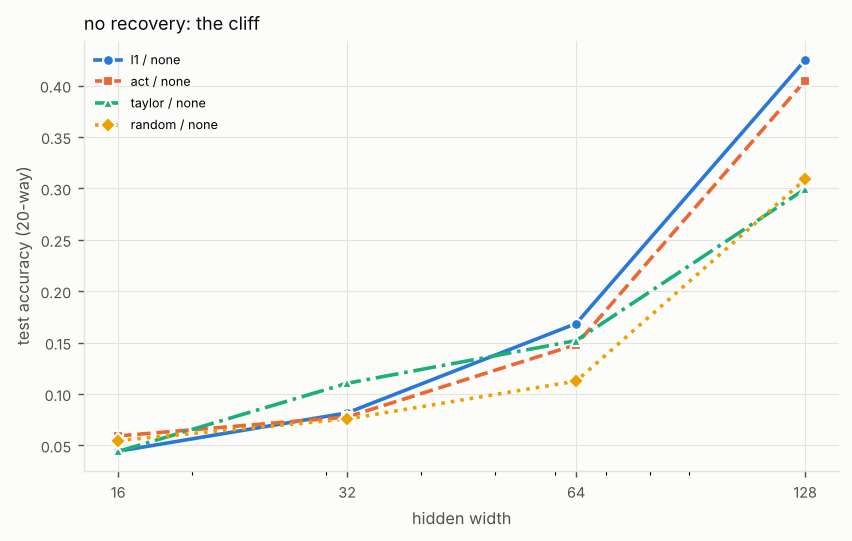
These are toy-MLP analogues, not YOLO. In prune_structured (lab/results/prune_structured.json), a 3x256 teacher cut to width 64 scores 0.1685 accuracy with no recovery and 0.8909 after fine-tuning on labels, the detector's fall-then-recover shape.
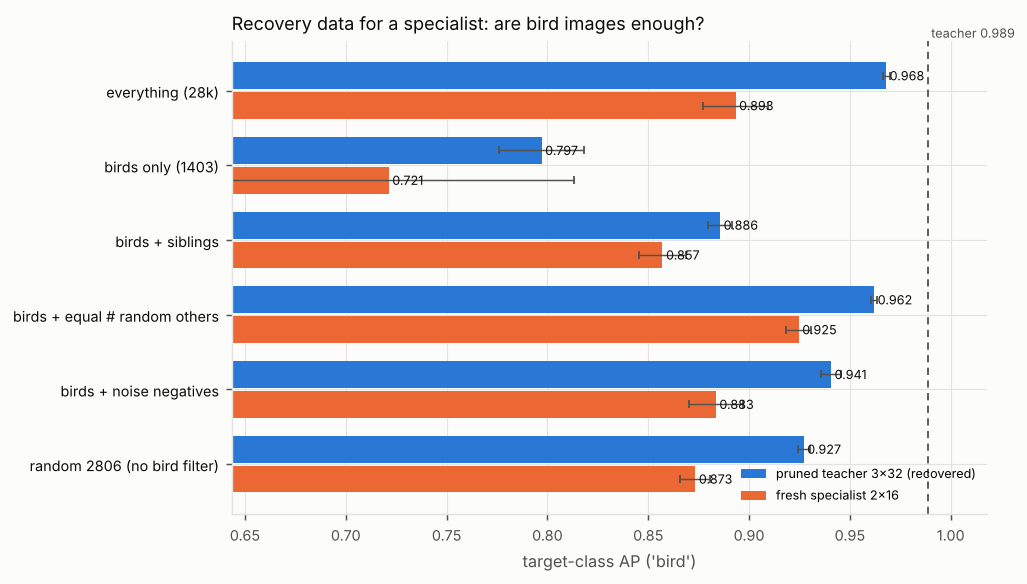
specialist_data (lab/results/specialist_data.json) asks whether the cockpit's all-bird recovery set is enough. A teacher pruned to 3x32 is recovered on different data and scored by bird average precision ("siblings" are the three bird-like classes; means of 2 seeds):
| recovery data | pruned 3x32 | fresh 2x16 |
|---|---|---|
| everything (28k) | 0.9679 | 0.8933 |
| birds only (1403) | 0.7971 | 0.7213 |
| birds + siblings | 0.8856 | 0.8571 |
| birds + equal # random others | 0.962 | 0.9246 |
| birds + noise negatives | 0.9406 | 0.8835 |
Birds alone gave the worst recovery; adding as many non-birds recovered almost everything. The cockpit's set is less extreme: its photos contain background, which the detection loss treats as negatives.
When it breaks
- A deeper one-shot cut recovers far less. One 20% cut fine-tuned for 40 epochs reached only 0.0706, while three 7.2% cuts with 15 epochs after each kept 0.2874 with 31% fewer params (STATUS.md, native 0.4284). Each step lost more: 0.3943, 0.3377, 0.2874.
- Recovered numbers lean optimistic. The validation split is the same 125 images as
eval_set/, andbest.ptis picked on it. - The curve (Ultralytics' mAP50, 125 images, QAT active) and before/after (cockpit scorer, 40 images, fused model) are different metrics.
- QAT trains per-tensor recipes per-channel (README.md), and
QATConv2dalways fits the range to the maximum, so an MSE-clipped recipe is trained on one grid and scored on another. - Masking equals Export only on the server. The browser edition can't run torch-pruning, so it masks each conv's lowest-L1 channels on its own, an optimistic preview.
Going further
To run it, build both datasets (python build_eval_set.py, python build_finetune_set.py), start uvicorn server:app --port 8000 --app-dir . and open http://localhost:8000. In Structure, press Scan, then "Apply cut" or click nodes. In Regrow, pick 6, 12 or 30 epochs and press Regrow. Headless: python recover_job.py --masks '{"model.9":0.3}' --quant '{"bits":4}' --epochs 12 --progress runs/recover_progress.json, or iterative_prune.py for repeated cuts (not yet a cockpit button). QAT in the same loop took a 3.16-bit recipe from 0.003 to 0.584, 70% of native, in 3 CPU epochs (STATUS.md, on a VOC-2007 bird stand-in set). STATUS.md's next steps are more bird images (2k or more), more epochs, and auto-shrink in the cockpit. The toy loop is lab/compress.py:structured_prune followed by ce_ft or kd_ft in lab/experiments/shrink.py.
Source code
The exact code the cockpit runs, read from the repository when this page was built.
removal_plan cockpit/harness/prune.py:143
def removal_plan(yolo, stage_fracs: dict[str, float],
                 example: torch.Tensor | None = None) -> dict[str, list[int]]:
    """The exact output channels `structured_prune_per_stage` would remove, as
    {conv name: channel indices}, without removing anything. Zeroing these
    channels (weight and bias) in the fused model reproduces the pruned model's
    outputs, because every coupled producer of a removed channel is listed.
    Call make_prunable(yolo) once first; the model is left unchanged.
    """
    model = yolo.model
    names = {m: n for n, m in model.named_modules()}
    pruner = _stage_pruner(model, stage_fracs, example)
    plan: dict[str, set[int]] = {}
    # importance is ranked before the first group is yielded, so not pruning
    # the groups as we go does not change which channels are picked
    for group in pruner.step(interactive=True):
        for dep, idxs in group:
            m = dep.target.module
            if isinstance(m, torch.nn.Conv2d) and pruner.DG.is_out_channel_pruning_fn(dep.handler):
                plan.setdefault(names[m], set()).update(int(i) for i in idxs)
    return {n: sorted(ix) for n, ix in plan.items()}
apply_plan cockpit/harness/mask.py:83
@torch.no_grad()
def apply_plan(model, plan: dict[str, list[int]]) -> None:
    """Zero the weight AND bias of each listed output channel of a fused model.
    With the bias zeroed too the channel outputs SiLU(0) = 0, exactly what its
    consumers would see if it were removed. `plan` is `prune.removal_plan`."""
    mods = dict(model.named_modules())
    for name, idx in plan.items():
        m = mods[name]
        m.weight[idx] = 0.0
        if m.bias is not None:
            m.bias[idx] = 0.0
main cockpit/recover_job.py:71
def main() -> None:
    ap = argparse.ArgumentParser()
    ap.add_argument("--masks", required=True)
    ap.add_argument("--quant", default="{}")
    ap.add_argument("--epochs", type=int, default=12)
    ap.add_argument("--progress", required=True)
    ap.add_argument("--native-map", type=float, default=None)
    a = ap.parse_args()
    masks = json.loads(a.masks)
    quant = json.loads(a.quant)
    pf = a.progress
    device = "mps" if torch.backends.mps.is_available() else "cpu"
    qat = quant.get("bits", 16) < 16 or any(b < 16 for b in quant.get("stage_bits", {}).values())

    try:
        write(pf, {"status": "pruning", "epoch": 0, "epochs": a.epochs})
        ev = BirdmAPEvaluator(os.path.join(HERE, "eval_set"), device=device,
                              max_images=LIVE_EVAL_IMAGES)
        y = YOLO(os.path.join(HERE, "yolov8n.pt"))
        make_prunable(y)
        if any(v > 0 for v in masks.values()):
            structured_prune_per_stage(y, masks)
        for p in y.model.parameters():
            p.requires_grad_(True)
        y.model.to(device)
        macs, params = tp.utils.count_ops_and_params(
            y.model, torch.randn(1, 3, 640, 640, device=device))
        before = cockpit_map(y, quant, ev)
        n_qat = 0
        if qat:
            n_qat = enable_qat(y.model, quant.get("bits", 16), quant.get("stage_bits"),
                               _gran(quant.get("granularity", "channel")),
                               quant.get("levels", "int"))

        state = {"status": "training", "epoch": 0, "epochs": a.epochs, "map": 0.0,
                 "params_m": round(params / 1e6, 3), "flops_g": round(macs / 1e9, 3),
                 "qat": qat, "qat_convs": n_qat, "before": round(before, 4),
                 "native": a.native_map, "curve": []}
        write(pf, state)

        trainer = y._smart_load("trainer")(overrides=dict(
            model=os.path.join(HERE, "yolov8n.pt"),
            data=os.path.join(HERE, "finetune_data", "data.yaml"),
            epochs=a.epochs, imgsz=640, batch=16, device=device,
            workers=0, amp=False, verbose=False, plots=False, cache=False,
            project=os.path.join(HERE, "runs"), name="recover", exist_ok=True,
        ))
        trainer.model = y.model.to(device)

        def on_epoch(tr):
            # Ultralytics fires this once more in final_eval() on a *fused* best.pt,
            # which drops the fake-quant; the cockpit-metric "after" covers that.
            if len(state["curve"]) >= a.epochs:
                return
            m = 0.0
            try:
                m = float(tr.metrics.get("metrics/mAP50(B)", 0.0))
            except Exception:
                pass
            state["epoch"] = tr.epoch + 1
            state["map"] = round(m, 4)
            state["curve"].append(round(m, 4))
            write(pf, state)

        trainer.add_callback("on_fit_epoch_end", on_epoch)
        trainer.train()

        state["status"] = "scoring"
        write(pf, state)
        best = YOLO(str(trainer.best))
        best.model.to(device)
        state["after"] = round(cockpit_map(best, quant, ev), 4)
        state["status"] = "done"
        state["best"] = os.path.relpath(str(trainer.best), HERE)
        write(pf, state)
    except Exception as e:
        write(pf, {"status": "error", "msg": str(e)})
        raise
Simulation figures
Structured (neuron) pruning: criteria, recovery, budget
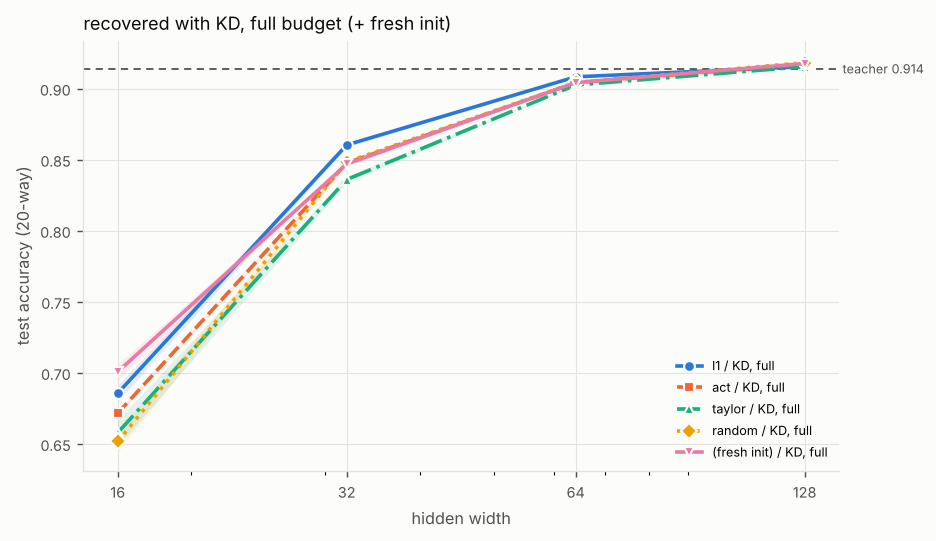
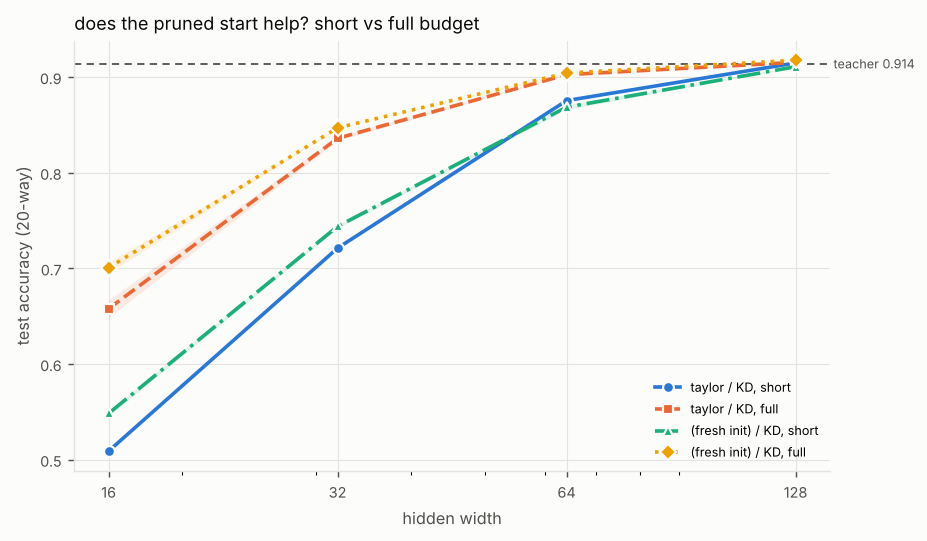
Delete whole neurons so the net is genuinely smaller. Which importance criterion picks the right ones, and is a pruned teacher a head start over training the small shape fresh, at the same number of training steps?
This figure did not load: the file is missing or the connection dropped. Reload the page to try again; the experiment's full table on the Results page has the same numbers.
This figure did not load: the file is missing or the connection dropped. Reload the page to try again; the experiment's full table on the Results page has the same numbers.
This figure did not load: the file is missing or the connection dropped. Reload the page to try again; the experiment's full table on the Results page has the same numbers.
'short' = 750 steps, 'full' = 3000 steps; pruned and fresh nets use the same optimizer and learning rate, so the only difference is the starting weights.
Full table: Structured (neuron) pruning: criteria, recovery, budget
Recovery data for a specialist: are bird images enough?
The YOLOv8n cockpit's recovery set is 400 images that all contain birds. If the recovery data only shows positives, can the model still learn what is NOT a bird?
This figure did not load: the file is missing or the connection dropped. Reload the page to try again; the experiment's full table on the Results page has the same numbers.
Full table: Recovery data for a specialist: are bird images enough?
Papers
- Han et al. (2015)
- Liu et al. Rethinking the Value of Network Pruning (2019)