The idea
Post-training quantization rounds a finished network and hopes it copes. Quantization-aware training (QAT) lets the network adapt to the rounding. It trains with quantized weights in the forward pass, so the loss sees the real rounding error, while a full-precision copy of every weight collects the updates. Rounding has zero derivative almost everywhere. The straight-through estimator (STE) handles this by pretending rounding is the identity in the backward pass: the gradient computed for the rounded weight is applied directly to the full-precision weight.
How it works
- Start from a trained full-precision network
W. - Each training step, compute
w_hat = quantize(W)with the same rule PTQ uses (here symmetric, per group of 16). - Forward pass with
w_hat, loss on labels or on the teacher's outputs (knowledge distillation, KD). - Backward pass: compute
dL/dw_hatas usual, then updateW -= lr * dL/dw_hat. This is the STE. - Small updates pile up in
Wuntil a weight crosses a rounding boundary and jumps to the next level. - Ship
quantize(W). The full-precision copy is thrown away.
for X, target in data:
    w_hat = fake_quantize(W, bits, 16)
    loss = L(forward(X, w_hat), target)
    W -= lr * grad(loss, w_hat)        # straight-through
The code, line by line
Nothing in lab/nn.py is QAT-specific. Two lines make it happen when net.qbits is set.
MLP.eff(i) returns the weight the network actually uses. w = self.W[i], then w = w * self.masks[i] if there is a mask, then w = fake_quantize(w, self.qbits, self.qgroup) if qbits is set. self.W[i] itself is never rounded. It is the full-precision copy.
MLP.forward calls w = self.eff(i) for every layer and, when cache=True, stores it in effs. MLP.backward then works on the quantized network as it really ran. gz is the gradient at the layer's pre-activation, and dW[i] = ins[i].T @ gz is dL/dw_hat, the gradient with respect to the rounded weight. g_in = gz @ effs[i].T passes the gradient back through the rounded weights, exactly as the network ran. fit hands dW + db to Adam together with net.params(), which is self.W + self.b, the full-precision tensors. That pairing, gradient for w_hat applied to W, is the whole straight-through estimator.
The scale is recomputed from W on every forward pass, so it tracks the weights but is not learned, as it is in Learned Step Size Quantization (Esser et al.). No gradient is clipped: the scale comes from the group's largest weight, so no weight ever falls outside the grid.
run_qat in lab/methods.py copies the model and sets m.qbits, m.qgroup = p["bits"], 16. It trains for FT = 500 steps at FT_LR = 3e-3, with scratch (labels) or distill (KD from the 3x256 teacher, at distill's default temperature T=1). The returned net keeps qbits set, so it is evaluated through the quantizer, next to PTQ at the same bits and group size.
What the simulations show
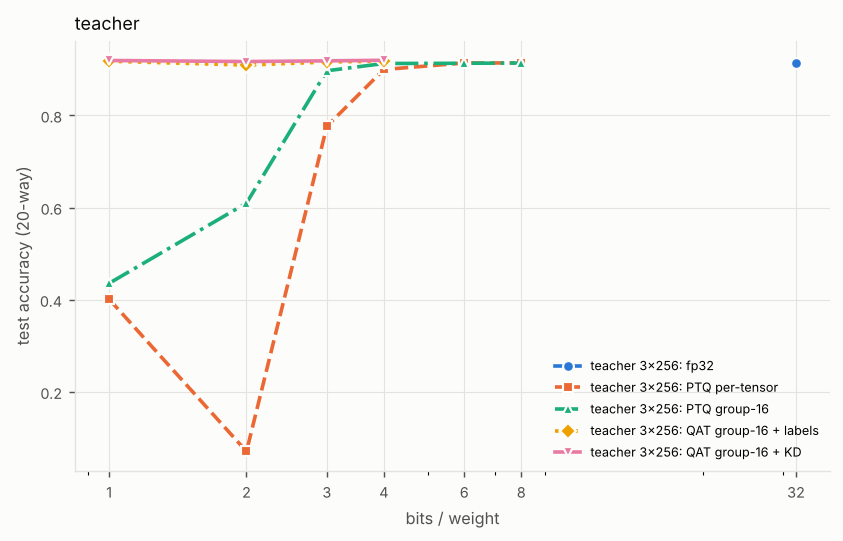
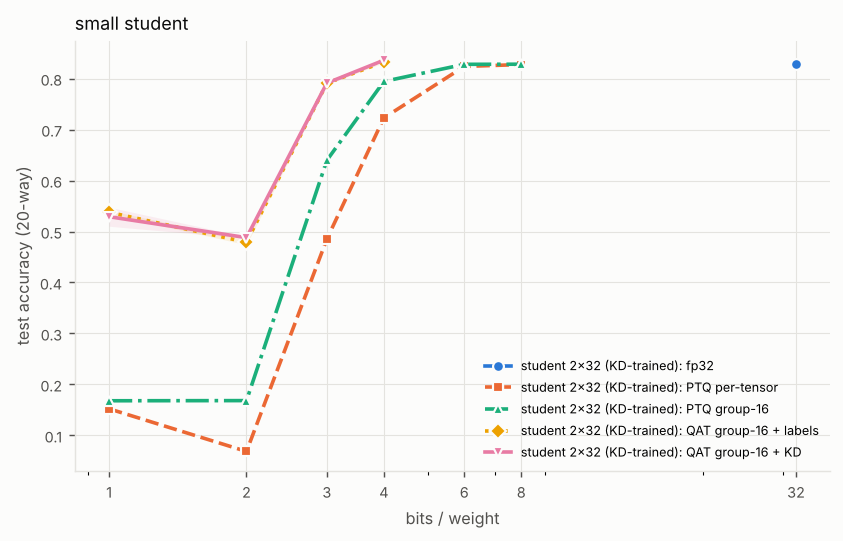
From quantization. QAT rows are 1,500 steps, mean of 2 seeds. Everything uses group-16 scales. Accuracy on 20 classes:
| model | bits | PTQ | QAT + labels | QAT + KD |
|---|---|---|---|---|
| teacher 3x256 (fp32 0.9139) | 3 | 0.8970 | 0.9160 | 0.9186 |
| teacher | 2 | 0.6098 | 0.9093 | 0.9171 |
| teacher | 1 | 0.4356 | 0.9178 | 0.9194 |
| student 2x32 (fp32 0.8281) | 4 | 0.7944 | 0.8327 | 0.8360 |
| student | 3 | 0.6397 | 0.7909 | 0.7912 |
| student | 2 | 0.1683 | 0.4789 | 0.4880 |
| student | 1 | 0.1680 | 0.5377 | 0.5291 |
The big teacher can be trained down to 1 bit per weight (plus one fp16 scale per 16 weights) and ends above its fp32 accuracy. That is not because the rounding helps: the QAT run is also 1,500 more training steps, which the fp32 model never got. The 2,132-parameter student cannot do the same. QAT roughly triples its 2-bit accuracy over PTQ but still ends far below fp32. Labels and KD come out almost even for the student. The bird AP at 2 bits even favours labels (0.7592 against 0.7024).
Page runs (500 steps): the default student at 2 bits goes from 0.1897 with PTQ to 0.4602 with KD (0.4260 with labels). A 2-bit student this small is chaotic: the same run in native numpy instead of the browser lands about 0.04 away, so read the KD lead as noise. The 2-seed means above have labels and KD within 0.01. The teacher at 1 bit goes from 0.4256 to 0.9118 with KD.
When it breaks
- No spare capacity. QAT redistributes knowledge across coarser weights. A capacity-limited model has nowhere to put it.
- STE mismatch. The gradient is for
w_hat, but the step is taken onW. A weight sitting just inside a rounding boundary gets the same gradient as one in the middle of its bin, so training can oscillate between levels. - Fixed scales. Recomputing
scalefrom the max means one weight growing changes the grid for its whole group mid-training. - Budget and learning rate. Too high a rate destroys the pretrained solution, and too few steps leave rounding damage unrepaired.
- Weights only. Activations stay in float here. Integer hardware also needs activation quantization, which QAT should simulate too.
Try this
- Keep model on student and step bits from 4 down to 1 with train with kd. Find where QAT stops closing the gap to fp32.
- At bits 2 on the student, compare train with labels and kd, and look at
target_apas well as accuracy. - Switch model to teacher and set bits to 1. Compare the PTQ row with the QAT row.
Going further
On large networks QAT is standard for int4 and below, usually with learned scales (LSQ), per-channel weight scales and simulated activation quantization, and often with distillation from the full-precision model, as in the KD arm here. The YOLOv8n cockpit's Precision module is PTQ, and carve.py found PTQ collapsing at 4 bits on YOLOv8n. Below that floor the cockpit uses QAT: when a recipe quantizes, Regrow fine-tunes with the quantizer in the loop. harness/precision.py:enable_qat swaps each quantized conv for a QATConv2d, whose forward pass uses the rounded weights and whose backward pass is a straight-through estimator (see Prune, then fine-tune). That took a 3.16-bit recipe from 0.003 to 0.584 bird mAP@50, 70% of native, in 3 CPU epochs (cockpit/STATUS.md, on a VOC-2007 bird stand-in set). See also Quantizing a detector.
Source code
The exact code that runs, read from the repository when this page was built.
MLP.eff lab/nn.py:125
    def eff(self, i: int) -> np.ndarray:
        w = self.W[i]
        if self.masks[i] is not None:
            w = w * self.masks[i]
        if self.qbits is not None:
            w = fake_quantize(w, self.qbits, self.qgroup)
            if self.masks[i] is not None:  # 1-bit sign() would revive pruned zeros
                w = w * self.masks[i]
        return w
MLP.backward lab/nn.py:158
    def backward(self, cache, dlogits: np.ndarray, dhid: dict[int, np.ndarray] | None = None,
                 hidden_grads: list | None = None):
        """Returns ``(grads, dX)`` where grads align with ``self.params()``.
        If ``hidden_grads`` is a list, dL/d(hidden[i]) is stored at index i."""
        ins, pre, effs = cache
        dW = [None] * self.n_layers
        db = [None] * self.n_layers
        g = dlogits
        if hidden_grads is not None:
            hidden_grads[:] = [None] * (self.n_layers - 1)
        for i in reversed(range(self.n_layers)):
            if hidden_grads is not None and i < self.n_layers - 1:
                hidden_grads[i] = g
            last_or_lin = i == self.n_layers - 1 or self.lin[i]
            gz = g if last_or_lin else g * (pre[i] > 0)
            dW[i] = ins[i].T @ gz
            db[i] = gz.sum(0)
            if self.masks[i] is not None:
                dW[i] *= self.masks[i]
            g_in = gz @ effs[i].T
            if self.res[i]:
                g_in = g_in + g
            if dhid is not None and (i - 1) in dhid:
                g_in = g_in + dhid[i - 1]
            g = g_in
        return dW + db, g
Simulation figures
Quantization: PTQ vs. QAT, labels vs. KD, big vs. small
How few bits per weight survive? Does a per-group scale rescue low bits, does quantization-aware training rescue more, and do small models tolerate it worse?
This figure did not load: the file is missing or the connection dropped. Reload the page to try again; the experiment's full table on the Results page has the same numbers.
This figure did not load: the file is missing or the connection dropped. Reload the page to try again; the experiment's full table on the Results page has the same numbers.
Full table: Quantization: PTQ vs. QAT, labels vs. KD, big vs. small
Papers
- Bengio et al. Estimating or Propagating Gradients Through Stochastic Neurons (2013)
- Esser et al. Learned Step Size Quantization (2020)