The idea
A generalist cut down to a bird specialist has to be fine-tuned back to health. The YOLOv8n cockpit does that on 400 COCO images that all contain birds. This page asks whether "only images of the target" is enough. A bird-vs-rest model must learn what is not a bird as much as what is, and a set of positives never shows it a negative. Recovery is knowledge distillation (KD) on whatever inputs it gets, so the input set is the only variable.
How it works
- Build recovery sets from the 28,000 available inputs (8,000 labeled plus 20,000 unlabeled), using the true class only to filter: everything; birds only (the 1,403 inputs of class 0); birds plus the 3 sibling classes; birds plus an equal number of random non-birds; birds plus the same number of Gaussian noise vectors; and 2 x 1,403 random inputs with no filter.
- Recover a specialist on each set with grouped KD: the teacher's probabilities (T=1) summed into 8 groups (bird, 3 siblings, 4 other superclasses).
- Two specialists: the teacher pruned to 3x32 with bird-aware importance and a collapsed head, and a fresh 2x16 net.
- Score both by bird average precision (AP) on the full 10,000-example test set.
The code, line by line
specialist_data in lab/experiments/specialist.py takes X_all, _ = transfer_X(d) and y_all = np.concatenate([d.train.y_clean, d.pool.y_clean]). bird = X_all[y_all == TARGET] has 1,403 rows (398 of them from the labeled set). pick = lambda m, n: X_all[m][rng.permutation(m.sum())[:n]] draws n random rows matching a mask, for the equal-count negatives.
In sets, "birds + siblings" uses np.isin(y_all, sib) with sib = d.world.siblings(TARGET), classes 1-3. "birds + noise negatives" appends rng.standard_normal((n_b, d.world.spec.d)). Inputs are standardized to mean 0 and standard deviation 1, so the noise lands where real data lives (average length 3.38 against 3.40): fake but plausible inputs.
sc = neuron_importance(t, probe.X, probe.y, "taylor", group=Gs["binary"]) is computed once (see Task-aware pruning). For each set and seed, pruned = collapse_head(structured_prune(t, [32] * 3, sc), Gm) rebuilds the carved specialist and spec_distill(pruned, t, Gm, s, X=X) recovers it on that set alone. spec_distill wraps X in FixedSource(X, None, K, teacher=t): no labels, only the teacher's outputs. The fresh arm is spec_distill(spec_student(16, Gm.shape[1], s), t, Gm, s, X=X). Both get the default step budget, so a small set is seen for many more epochs than a large one.
run_spec_data in lab/methods.py trains the fresh 2x16 arm for one seed and 1,000 steps on the chosen set. Unless the choice is "everything", it also trains the same net on everything for comparison.
What the simulations show
From specialist_data (bird AP, mean of 2 seeds; the teacher gets 0.9885):
| recovery inputs | pruned teacher 3x32 (recovered) | fresh specialist 2x16 |
|---|---|---|
| everything (28,000) | 0.9679 | 0.8933 |
| birds only (1,403) | 0.7971 | 0.7213 |
| birds + siblings | 0.8856 | 0.8571 |
| birds + equal number of random others (2,806) | 0.9620 | 0.9246 |
| birds + noise negatives (2,806) | 0.9406 | 0.8835 |
| random 2,806, no bird filter | 0.9271 | 0.8733 |
Bird-only recovery is the worst set for both models. The carved model drops from 0.9679 to 0.7971, and the fresh one from 0.8933 to 0.7213 (seed spread 0.092). Negatives are what pin down where "bird" ends. The 3 sibling classes, the closest confusers, recover about half of the carved model's loss (0.8856). Birds plus an equal number of random non-birds nearly matches all 28,000 inputs for the carved model (0.9620) and beats it for the fresh one (0.9246), with a tenth of the data. A random sample of the same size (about 5% birds) does worse, so the ratio of positives matters too. Even Gaussian noise negatives get the carved model to 0.9406, because standardized noise overlaps the real inputs.
Page runs (fresh 2x16, 1,000 steps, one seed): everything 0.8372, birds only 0.6439, birds + random others 0.9054, birds + noise 0.8094.
The toy's "birds only" is purer than any real image set: every input is a positive with nothing else in it.
When it breaks
- No negatives, no boundary. On a bird-only set nothing pins down the outputs away from birds, so what the model says there is an accident.
- Inherited boundaries drift too. The carved model starts with a boundary, but bird-only data drags it: it lost as much AP (0.17) as the fresh one.
- Fake negatives work only where they land. Standardized noise overlaps real inputs here. Random noise images look nothing like real non-bird scenes, so don't expect that result to transfer.
Try this
- Run recovery inputs = birds only and compare with the "everything" row the page adds.
- Run birds + random others: same birds plus an equal number of negatives. Does it beat everything?
- Run birds + noise and compare with birds + random others, fake negatives against real ones.
Going further
The cockpit's recovery set (build_finetune_set.py) is 400 COCO images containing birds, labelled in the model's 80-class space with bird = class 14. A detection image is not a toy "bird input": it also contains background, and a detector learns from the locations where no bird is, so the cockpit's set is not purely positive. The toy does say that the non-bird content matters, and that a balanced mix of positives and negatives from everything else worked better than near-confusers alone. For the cockpit, adding a similar number of COCO images without birds is the analogue of "birds + random others". STATUS.md lists more training data (2k+ bird images) as the first lever for stronger recovery. The toy suggests checking what those images contain besides birds.
Source code
The exact code that runs, read from the repository when this page was built.
specialist_data lab/experiments/specialist.py:141
@experiment("specialist_data", G, "Recovery data for a specialist: are bird images enough?",
            "The YOLOv8n cockpit's recovery set is 400 images that *all contain birds*. If the "
            "recovery data only shows positives, can the model still learn what is NOT a bird?")
def specialist_data():
    d = data()
    t = teacher()
    Gs = groups(d.world)
    Gm = Gs["supers"]
    X_all, _ = transfer_X(d)
    y_all = np.concatenate([d.train.y_clean, d.pool.y_clean])
    sib = d.world.siblings(TARGET)
    rng = np.random.default_rng(0)
    bird = X_all[y_all == TARGET]
    n_b = len(bird)
    pick = lambda m, n: X_all[m][rng.permutation(m.sum())[:n]]
    sets = {
        "everything (28k)": X_all,
        f"birds only ({n_b})": bird,
        "birds + siblings": X_all[(y_all == TARGET) | np.isin(y_all, sib)],
        "birds + equal # random others": np.concatenate([bird, pick(y_all != TARGET, n_b)]),
        "birds + noise negatives": np.concatenate([bird, rng.standard_normal(
            (n_b, d.world.spec.d)).astype(np.float32)]),
        f"random {2 * n_b} (no bird filter)": X_all[rng.permutation(len(X_all))[:2 * n_b]],
    }
    probe = d.train.take(2000)
    sc = neuron_importance(t, probe.X, probe.y, "taylor", group=Gs["binary"])
    rows = []
    for name, X in sets.items():
        for s in SEEDS[:2]:
            pruned = collapse_head(structured_prune(t, [32] * 3, sc), Gm)
            r = spec_eval(spec_distill(pruned, t, Gm, s, X=X))
            rows.append(dict(data=name, model="pruned teacher 3x32 (recovered)", seed=s, **r))
            r = spec_eval(spec_distill(spec_student(16, Gm.shape[1], s), t, Gm, s, X=X))
            rows.append(dict(data=name, model="fresh specialist 2x16", seed=s, **r))
    return dict(rows=agg(rows, ["data", "model"]), refs=refs(t), plots=[
        dict(x="data", y="target_ap", group="model", kind="bar", hlines=["teacher"],
             ref_metric="target_ap"),
    ])
Simulation figures
Recovery data for a specialist: are bird images enough?
The YOLOv8n cockpit's recovery set is 400 images that all contain birds. If the recovery data only shows positives, can the model still learn what is NOT a bird?
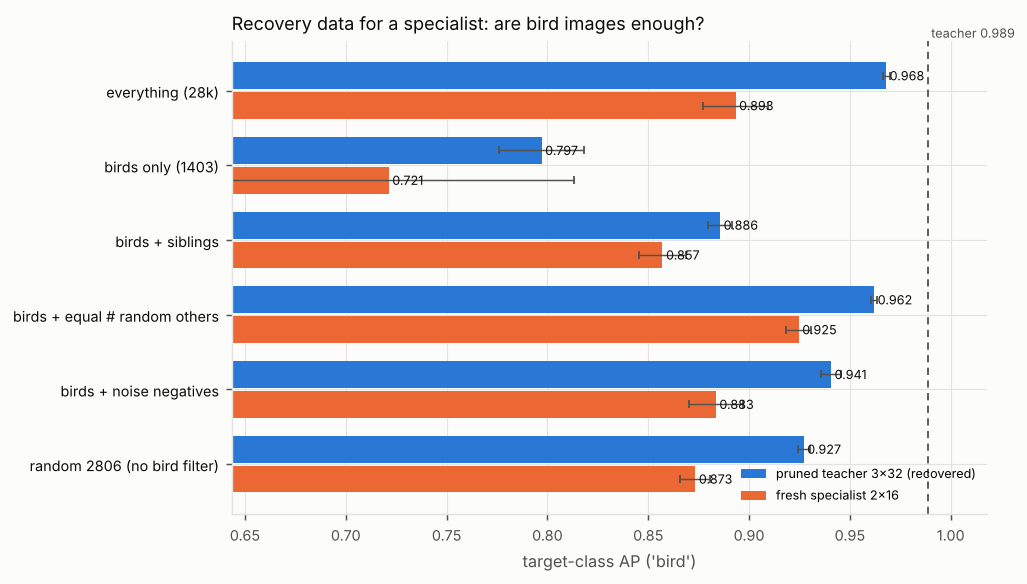
This figure did not load: the file is missing or the connection dropped. Reload the page to try again; the experiment's full table on the Results page has the same numbers.
Full table: Recovery data for a specialist: are bird images enough?
Papers
No papers are listed for this method.