The idea
Ordinary importance scores ask which neurons matter for everything the network does. Task-aware pruning scores neurons by how much they matter for the kept task alone, here a bird-vs-rest loss instead of 20-class cross-entropy, so neurons that only separate two kinds of vehicle are cut first. The output layer is then collapsed to a coarser label space, and the network is recovered by distilling only that grouped task. It is the toy version of the YOLOv8n cockpit's job: carving a bird detector out of an 80-class YOLO.
How it works
- Group the 20 classes, each grouping a
C x K0/1 matrixG. Scoring usesbinary(bird | rest). The head usessupers(bird | 3 siblings | 4 other superclasses). - Score each hidden neuron with the Taylor criterion,
sum over examples of |a * dL/da|, whereL = -log q[true group]andq = softmax(z) @ G. - Keep the top
wneurons per layer (structured pruning). - Collapse the 20-way output layer to
Koutputs, each the mean of its member classes' weights. - Recover with grouped knowledge distillation (KD): the teacher's probabilities summed into the same
Kgroups.
The code, line by line
neuron_importance in lab/compress.py, with method="taylor" and a group matrix, starts like plain Taylor. It then builds the gradient of the grouped loss with respect to the 20 logits. yg = group[y].argmax(1) maps each example's class to its group. Gy = group[:, yg].T is an N x C matrix with 1 for every class in the example's true group. qy = (p * Gy).sum(1, keepdims=True) is the probability of that group, and dz = (p - p * Gy / qy) / len(z) is the gradient of -log qy. For a non-bird example the true group is all 19 other classes, and for each of them the gradient is p_c * (1 - 1 / qy), proportional to p_c. It never reshuffles probability inside the group, so only the bird-vs-rest boundary produces a signal. The score is then np.abs(h * g).sum(0) as usual.
collapse_head copies the net. norm = G / G.sum(0, keepdims=True) divides each column of G by its group size, so net.W[-1] @ norm turns the 256x20 output matrix into a 256xK one whose column k averages its members' columns. The bias is treated the same way. The bird is a group of one, so its logit is copied exactly. Its probability still changes, because the softmax now runs over 8 averaged logits. Averaging logits is not summing probabilities, so merged groups need recovery.
run_task_prune in lab/methods.py scores with group=G["binary"] ("bird") or None ("all classes"), prunes the 3x256 teacher to [w] * 3, collapses to the 8-output supers head, and recovers a copy with S.spec_distill(cut.copy(), t, G["supers"], 0, steps=FT, lr=FT_LR) (grouped KD at T=1). The .copy() matters: spec_distill trains in place, so without it the "no recovery" row would show the recovered network.
What the simulations show
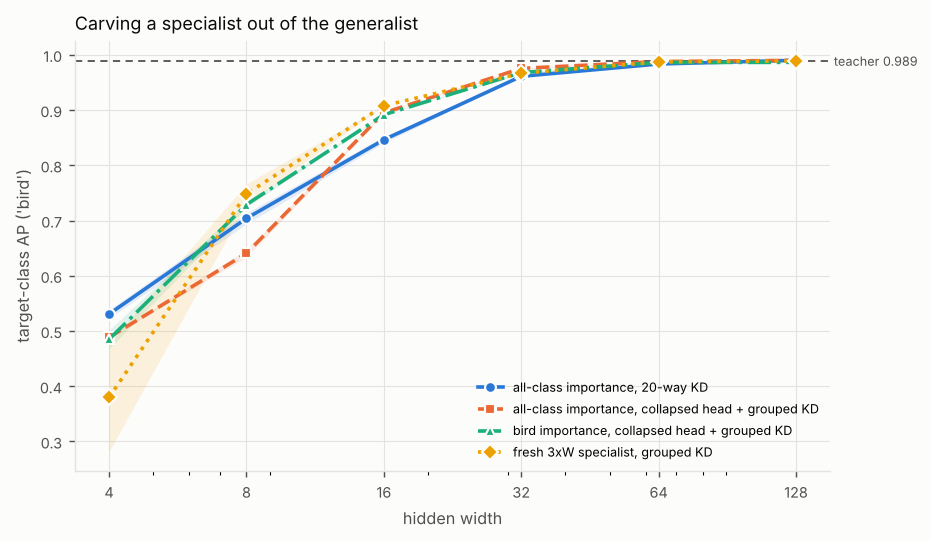
From specialist_prune (bird AP; recovered arms are means of 2 seeds with the same 3,000 steps as the fresh specialist; teacher AP 0.9885):
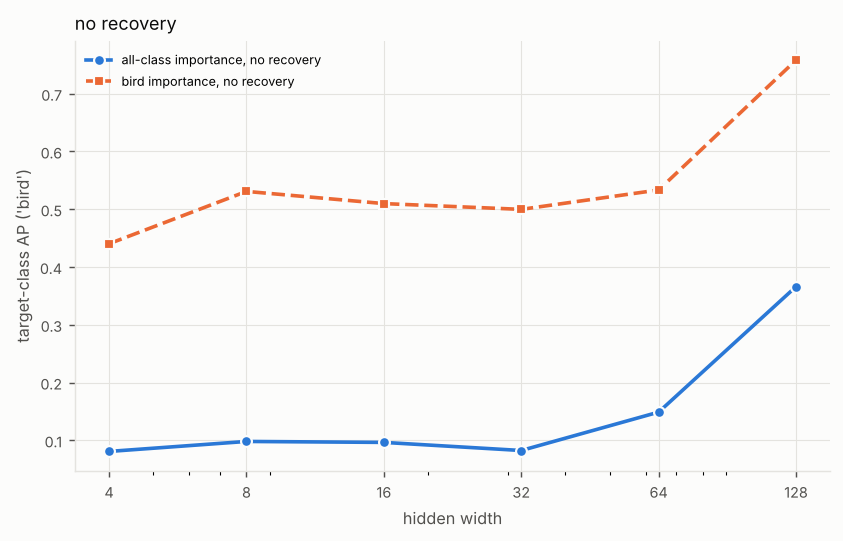
| keep width | all-class, none | bird, none | all-class, 20-way KD | all-class, collapsed + grouped KD | bird, collapsed + grouped KD | fresh 3xW specialist |
|---|---|---|---|---|---|---|
| 128 | 0.3660 | 0.7581 | 0.9901 | 0.9900 | 0.9864 | 0.9889 |
| 64 | 0.1487 | 0.5333 | 0.9834 | 0.9879 | 0.9862 | 0.9873 |
| 32 | 0.0823 | 0.4997 | 0.9611 | 0.9755 | 0.9679 | 0.9667 |
| 16 | 0.0963 | 0.5097 | 0.8464 | 0.8950 | 0.8916 | 0.9079 |
| 8 | 0.0980 | 0.5308 | 0.7040 | 0.6406 | 0.7289 | 0.7485 |
| 4 | 0.0807 | 0.4403 | 0.5308 | 0.4885 | 0.4850 | 0.3796 |
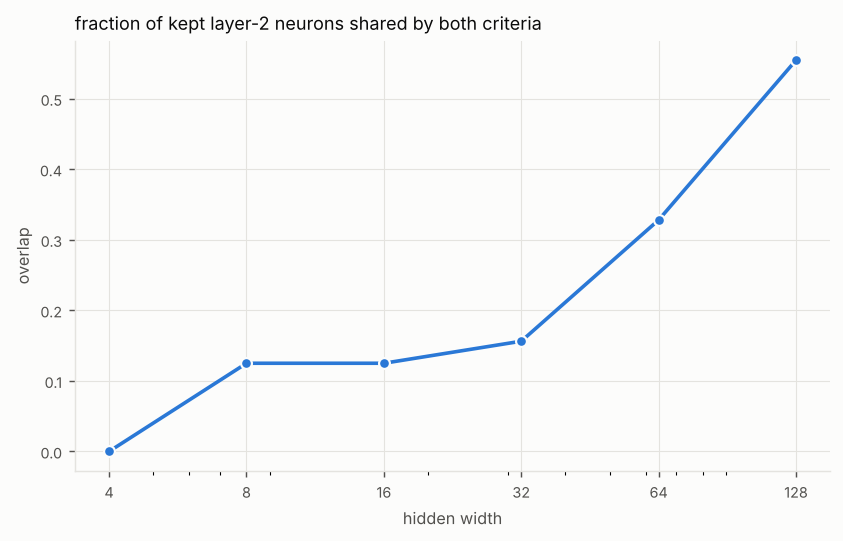
Before recovery, task-aware scoring does what it promises: the bird-scored cut keeps 0.44-0.76 bird AP at every width, against 0.08-0.37 for the all-class cut. The criteria pick different neurons. In the second hidden layer the kept sets overlap by 55% at width 128, 33% at 64, 16% at 32 and 0% at 4. After full recovery the advantage mostly disappears. From width 16 up the all-class carve recovers as well or slightly better, the bird-scored carve wins clearly only at width 8 (0.7289 against 0.6406), and at 8 and 16 a fresh specialist beats both. Collapsing the head beats 20-way KD at widths 16-64 (0.8950 against 0.8464 at 16), but not below.
Page runs (500 recovery steps, one seed; "no recovery" measured after the head collapse): at width 16, bird importance goes from 0.4964 to 0.7735 and all-class from 0.0628 to 0.6328. At width 64, bird goes from 0.5490 to 0.9715 and all-class from 0.1221 to 0.9722.
The toy's answer: task-aware importance matters when recovery is short or impossible. With enough recovery, how many neurons you keep matters more than which.
When it breaks
- Scored for a different question. Neurons were scored for 2 outputs but the head keeps 8, so the sibling outputs start with little support.
- Rare target, noisy scores. Only 101 of the 2,000 probe examples are birds.
- Collapsed heads start uncalibrated. Averaged logits are only an initialization for merged groups.
- Fresh specialists can win. Check that baseline.
Try this
- Set keep width 64 and compare importance for bird and all classes, first in the "no recovery" rows, then after recovery.
- Repeat at keep width 16, a 16x cut per layer.
- Step keep width from 128 down to 4 with importance for bird and find where recovery stops reaching the teacher row's 0.9888.
Going further
On a detector the recipe means scoring channels with a loss that counts only the target class, for example a Taylor importance on detection loss restricted to class 14, in place of the cockpit's GroupMagnitudeImportance, which like l1 ignores the task. The cockpit already measures task sensitivity directly: its sensitivity scan cuts 25% of each stage, records the drop in bird mAP@50, and ranks stages by FLOPs per unit of sensitivity. Head collapse is still open: the cockpit's README notes that specializing to pigeons specifically, rather than all birds, would need "head collapse to one class".
Source code
The exact code that runs, read from the repository when this page was built.
neuron_importance lab/compress.py:120
def neuron_importance(net: MLP, X: np.ndarray, y: np.ndarray | None = None,
                      method: str = "l1", rng: np.random.Generator | None = None,
                      group: np.ndarray | None = None) -> list[np.ndarray]:
    """One score per hidden neuron, per hidden layer (higher = keep).

    l1        -- L1 norm of the neuron's incoming weights (torch-pruning's
                 GroupMagnitudeImportance, the criterion the YOLOv8n cockpit uses)
    act       -- mean |activation| on data
    taylor    -- |a * dL/da| summed over data: first-order estimate of the loss
                 change if the neuron is removed (data- and task-aware)
    random    -- control
    ``group`` (C x K 0/1 matrix) makes 'taylor' task-aware: the loss becomes CE
    in the grouped label space (e.g. bird-vs-rest), asking "which neurons matter
    for *this* task?" rather than for all 20 classes.
    """
    n_hidden = net.n_layers - 1
    if method == "random":
        rng = rng or np.random.default_rng(0)
        return [rng.random(net.sizes[i + 1]) for i in range(n_hidden)]
    if method == "l1":
        return [np.abs(net.W[i]).sum(0) for i in range(n_hidden)]
    z, hid, cache = net.forward(X, cache=True)
    if method == "act":
        return [np.abs(h).mean(0) for h in hid]
    if method == "taylor":
        p = softmax(z)
        if group is None:
            dz = (p - np.eye(z.shape[1], dtype=F)[y]) / len(z)
        else:  # d/dz of -log q[yg], q = p @ G:  p - p * G[:, yg] / q[yg]
            yg = group[y].argmax(1)
            Gy = group[:, yg].T
            qy = (p * Gy).sum(1, keepdims=True)
            dz = (p - p * Gy / qy) / len(z)
        hg: list = []
        net.backward(cache, dz, hidden_grads=hg)
        return [np.abs(h * g).sum(0) for h, g in zip(hid, hg)]
    raise ValueError(method)
collapse_head lab/compress.py:170
def collapse_head(net: MLP, G: np.ndarray) -> MLP:
    """Shrink the output layer to a coarser label space (C -> K): each new
    output starts as the mean of its member classes' weights. Exact for
    singleton groups (e.g. 'bird' stays bird); an init for merged ones."""
    net = net.copy()
    norm = G / G.sum(0, keepdims=True)
    net.W[-1] = (net.W[-1] @ norm).astype(F)
    net.b[-1] = (net.b[-1] @ norm).astype(F)
    net.masks[-1] = None
    net.sizes[-1] = G.shape[1]
    return net
Simulation figures
Carving a specialist out of the generalist
Prune the teacher's neurons for one class. Does a task-aware importance score (bird-vs-rest) keep a better bird detector than an all-class score, and does collapsing the head help recovery?
This figure did not load: the file is missing or the connection dropped. Reload the page to try again; the experiment's full table on the Results page has the same numbers.
This figure did not load: the file is missing or the connection dropped. Reload the page to try again; the experiment's full table on the Results page has the same numbers.
This figure did not load: the file is missing or the connection dropped. Reload the page to try again; the experiment's full table on the Results page has the same numbers.
Papers
- Molchanov et al. (2019)
- Kim et al. Task-Specific Pruning (various)