The idea
Uniform quantization spaces its levels evenly between -max and +max, but most trained weights sit near zero, so most levels go unused. Weight sharing lets the data choose the levels: k-means on a layer's weight values finds k centroids, and each weight is replaced by its nearest one. Storage is a log2(k)-bit index per weight plus a k-float codebook per layer.
How it works
- Take each layer's weights as a 1-D list (skipping pruned zeros).
- Initialise
kcentroids evenly spaced from the smallest to the largest value (linear init). - Repeat: assign each weight to its nearest centroid, move each centroid to its weights' mean (Lloyd's algorithm).
- Replace each weight by its centroid.
- Optionally fine-tune and snap the weights back to a codebook.
c = linspace(v.min(), v.max(), k)
for _ in range(iters):
    a = argmin_j |v - c[j]|
    c[j] = mean(v[a == j])     # for each non-empty j
w_shared = c[a]
The code, line by line
kmeans_share in lab/compress.py copies the net and loops over every layer; biases stay in float. w = net.W[i].reshape(-1) flattens the matrix, and nz = w != 0 if net.masks[i] is not None else ... makes a pruned layer cluster only its surviving weights, so zeros stay zero. v = w[nz] is the list to cluster.
c = np.linspace(v.min(), v.max(), k) is the linear init, which Han et al. preferred because it keeps centroids on the rare large weights. Each of 25 iterations computes a = np.abs(v[:, None] - c[None]).argmin(1): the broadcast builds an (n_weights, k) distance table and argmin(1) picks each weight's nearest centroid. c[j] = v[a == j].mean() moves each centroid to its members' mean, and the if (a == j).any() guard leaves empty clusters in place instead of producing NaN. A final assignment and out[nz] = c[a] write the centroid values back.
The result is a float matrix with at most k distinct values per layer. params counts nonzero weights, and centroids are almost never 0, so it stays at 140,052 although storage drops to log2(k) bits per weight.
run_weight_sharing in lab/methods.py and the weight_sharing experiment both compare at equal storage: quantize(t, bits) per tensor, with bits = ceil(log2(k)), against k centroids. That is 2^b - 1 uniform levels against 2^b. Fine-tuning runs kmeans_share(distill(m, t, r, steps=FT // 2, lr=FT_LR), k) twice: KD moves the weights off their centroids, then they are re-clustered and snapped. Deep Compression instead trains the centroids themselves, summing the gradients of all weights that share one, so weights never leave the codebook.
What the simulations show
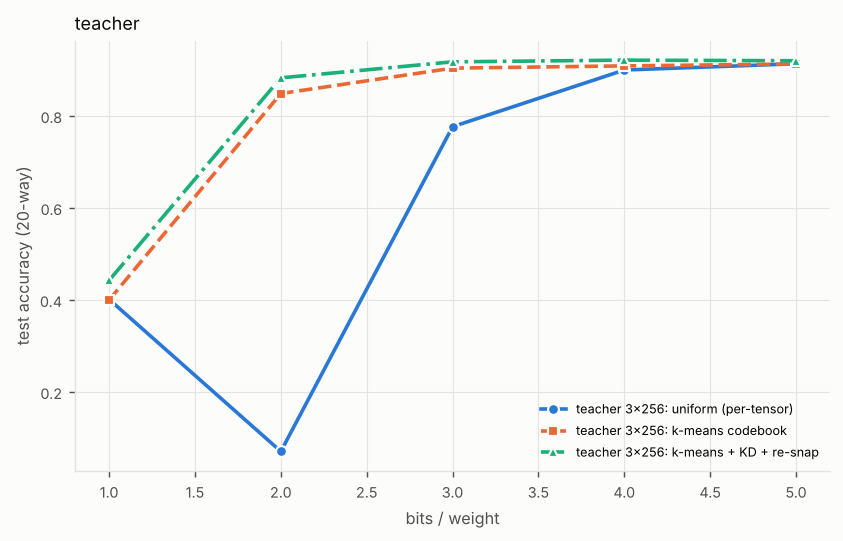
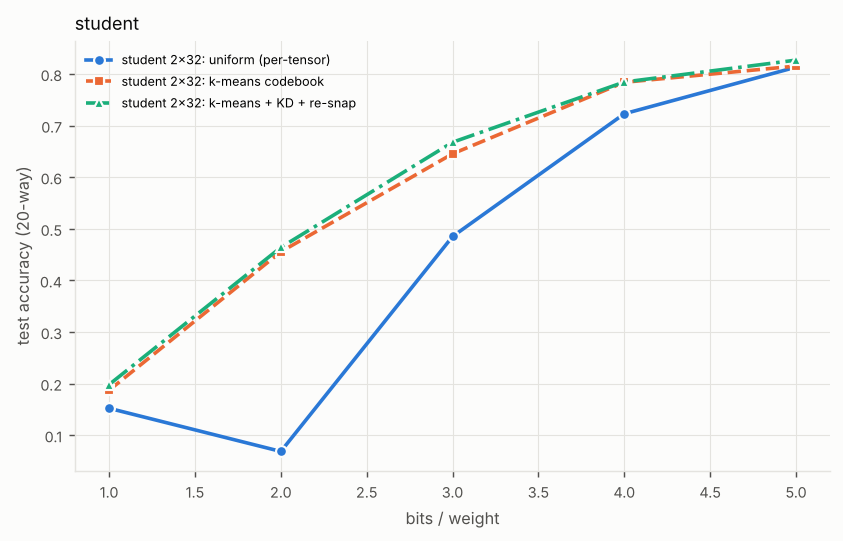
From weight_sharing, at equal bits per weight (accuracy on 20 classes; the student is the 2x32 net distilled from the teacher):
| bits (k) | teacher uniform | teacher k-means | teacher + KD + re-snap | student uniform | student k-means | student + KD + re-snap |
|---|---|---|---|---|---|---|
| 1 (2) | 0.4013 | 0.3999 | 0.4426 | 0.1522 | 0.1872 | 0.1981 |
| 2 (4) | 0.0707 | 0.8487 | 0.8828 | 0.0686 | 0.4555 | 0.4639 |
| 3 (8) | 0.7766 | 0.9039 | 0.9176 | 0.4851 | 0.6453 | 0.6677 |
| 4 (16) | 0.8998 | 0.9088 | 0.9213 | 0.7229 | 0.7839 | 0.7844 |
| 5 (32) | 0.9134 | 0.9129 | 0.9200 | 0.8132 | 0.8153 | 0.8268 |
At the same storage, a learned codebook beats the uniform grid at 2, 3 and 4 bits on both models. At 2 bits, uniform symmetric is ternary, {-s, 0, +s} with s the largest weight, so most weights round to zero (teacher 0.0707), while 4 k-means values keep 0.8487. At 1 bit both have two levels and score alike; at 5 bits both are near lossless. The student, with less spare capacity, loses more at every width: at 3 bits its k-means accuracy is 0.6453 against 0.8281 in fp32, while the teacher keeps 0.9039 against 0.9139. KD fine-tuning with re-snapping helps the teacher at every k, ending above fp32 from 8 values up, which is partly just extra training on 28,000 inputs. For the student it adds at most 0.0224.
Page runs at the defaults (k = 4, fine-tune on): uniform 2-bit 0.0562, k-means 0.8534, after KD and re-snap 0.8718. At k = 2: uniform 1-bit 0.4015, k-means 0.4494, after KD and re-snap 0.4586. Symmetric 2-bit is ternary {-s, 0, +s}, which is why it scores below 1-bit sign quantization.
When it breaks
- Re-snapping throws away part of the fine-tune. Free fine-tuning moves weights off their centroids, and each snap pulls them back. Training that keeps weights tied to centroids (shared-gradient centroid updates) avoids the round trip.
- One codebook per layer is coarse. Rows with very different scales get centroids that fit neither. Per-group codebooks or group-scaled uniform grids can beat it.
- **Tiny
k.** Two values per layer is a signed binary pattern, which a small network cannot absorb. - Clustering cost. The
(n, k)distance table grows with layer size timesk, so large models cluster in chunks. - Hardware. Codebook indices need a lookup per weight, which integer matmul units can't do directly.
Try this
- Set values per layer to 4 with fine-tune + re-snap off, then 8, then 16. The page's uniform row gets an extra bit. Watch k-means lose its lead as
kgrows. - At values per layer 2 and 16, toggle fine-tune + re-snap and compare what the KD row adds.
- Set values per layer to 3. The uniform row reads 2-bit: the page rounds
log2(3)up toceil(log2(3))= 2 bits, which for symmetric rounding is also 3 levels,{-s, 0, +s}. Same level count, almost the same storage (k-means adds a 3-value codebook per layer): compare where the two put their levels.
Going further
Deep Compression chains pruning, then weight sharing with centroid fine-tuning, then Huffman coding of the indices. Modern non-uniform formats use fixed codebooks (QLoRA's NF4 levels follow a normal distribution) or learned vector codebooks. The YOLOv8n cockpit's harness only does uniform symmetric quantization (harness/quant.py). The teacher results above suggest a per-layer codebook could beat per-tensor uniform at 2-3 bits, and at equal storage the student benefited too. A per-layer k-means codebook could be added to harness/model.py beside apply_uniform and swept with carve.py.
Source code
The exact code that runs, read from the repository when this page was built.
kmeans_share lab/compress.py:195
def kmeans_share(net: MLP, k: int, iters: int = 25, seed: int = 0) -> MLP:
    """Deep-Compression weight sharing: each layer's weights snap to one of
    ``k`` centroids (k-means on the 1-D weight values; linear init). Storage is
    log2(k) bits/weight + a k-entry codebook. Non-uniform, unlike ``quantize``."""
    net = net.copy()
    for i in range(net.n_layers):
        w = net.W[i].reshape(-1)
        nz = w != 0 if net.masks[i] is not None else np.ones_like(w, bool)
        v = w[nz]
        c = np.linspace(v.min(), v.max(), k)
        for _ in range(iters):
            a = np.abs(v[:, None] - c[None]).argmin(1)
            for j in range(k):
                if (a == j).any():
                    c[j] = v[a == j].mean()
        a = np.abs(v[:, None] - c[None]).argmin(1)
        out = w.copy()
        out[nz] = c[a]
        net.W[i] = out.reshape(net.W[i].shape).astype(F)
    return net
Simulation figures
Weight sharing (k-means codebooks) vs. uniform bits
Deep-Compression style: each layer keeps only k distinct values. At the same bits/weight, does a learned, non-uniform codebook beat uniform rounding?
This figure did not load: the file is missing or the connection dropped. Reload the page to try again; the experiment's full table on the Results page has the same numbers.
This figure did not load: the file is missing or the connection dropped. Reload the page to try again; the experiment's full table on the Results page has the same numbers.
Both schemes store b bits per weight: k-means has k = 2^b levels per layer, symmetric uniform has 2^b - 1 (1 bit = sign x mean|w|, i.e. 2 levels).
Full table: Weight sharing (k-means codebooks) vs. uniform bits
Papers
- Han et al. Deep Compression (2016)