Students don't match their teachers
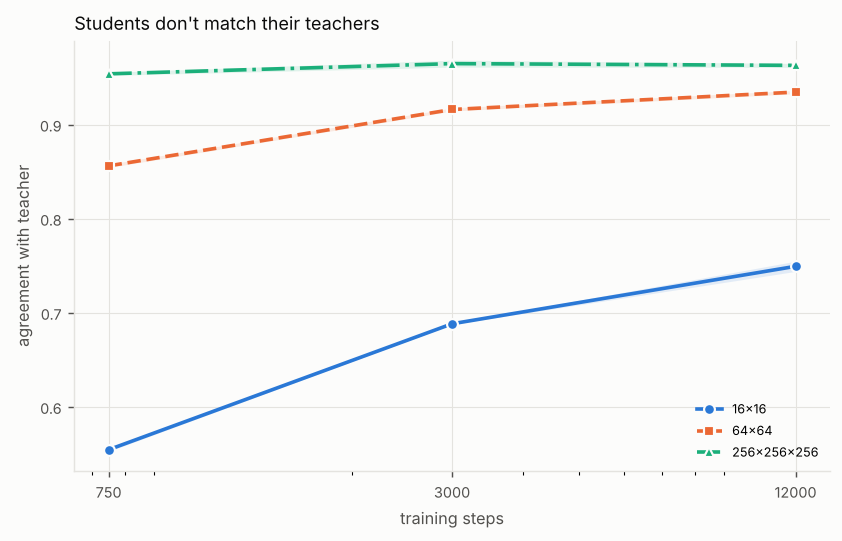
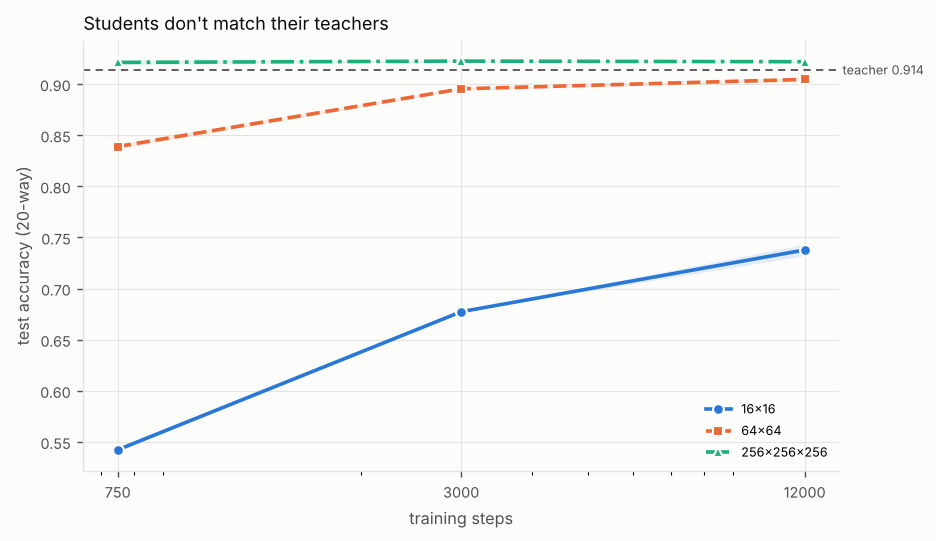
Even a student big enough to copy the teacher exactly often doesn't. How does agreement with the teacher grow with capacity and training length?
This figure did not load: the file is missing or the connection dropped. Reload the page to try again; the table below has the same numbers.
This figure did not load: the file is missing or the connection dropped. Reload the page to try again; the table below has the same numbers.
Table
Mean over the seeds; ± is the standard deviation where more than one seed ran. The experiment took 213 s.
| Student | Training steps | Test accuracy (20-way) | Target-class AP ('bird') | Agreement with teacher | Test NLL | KL(Bayes || model) | Parameters (nonzero) |
|---|---|---|---|---|---|---|---|
| 16x16 | 750 | 0.542 ± 0.002 | 0.776 ± 0.024 | 0.554 ± 0.002 | 1.346 ± 0.016 | 1.263 ± 0.019 | 820 |
| 16x16 | 3,000 | 0.677 ± 0.000 | 0.860 ± 0.000 | 0.688 ± 0.001 | 0.979 ± 0.019 | 0.898 ± 0.019 | 820 |
| 16x16 | 12,000 | 0.738 ± 0.006 | 0.893 ± 0.003 | 0.749 ± 0.005 | 0.797 ± 0.013 | 0.716 ± 0.012 | 820 |
| 64x64 | 750 | 0.839 ± 0.002 | 0.960 ± 0.000 | 0.856 ± 0.002 | 0.494 ± 0.003 | 0.413 ± 0.004 | 6,292 |
| 64x64 | 3,000 | 0.895 ± 0.001 | 0.983 ± 0.003 | 0.916 ± 0.002 | 0.319 ± 0.001 | 0.240 ± 0.000 | 6,292 |
| 64x64 | 12,000 | 0.905 ± 0.002 | 0.985 ± 0.001 | 0.934 ± 0.002 | 0.333 ± 0.003 | 0.255 ± 0.003 | 6,292 |
| 256x256x256 | 750 | 0.921 ± 0.002 | 0.990 ± 0.001 | 0.954 ± 0.002 | 0.246 ± 0.005 | 0.169 ± 0.006 | 140,052 |
| 256x256x256 | 3,000 | 0.922 ± 0.001 | 0.989 ± 0.000 | 0.965 ± 0.004 | 0.291 ± 0.002 | 0.214 ± 0.002 | 140,052 |
| 256x256x256 | 12,000 | 0.922 ± 0.001 | 0.990 ± 0.000 | 0.963 ± 0.002 | 0.301 ± 0.000 | 0.225 ± 0.001 | 140,052 |
Reference points
- Teacher (the large model)
- The full-size network trained on the labeled data; the smaller models here are measured against it. Test accuracy (20-way) 0.914, target-class AP ('bird') 0.989, test NLL 0.384, KL(Bayes || model) 0.309, parameters (nonzero) 140,052.
- Bayes-optimal (the best any model can do on this problem)
- Predictions from the exact class probabilities, which the lab can compute because it generated the data. Test accuracy (20-way) 0.973, target-class AP ('bird') 0.999, test NLL 0.079.
Birds in this experiment
The table's 6 smaller models hatch 3 kinds of bird. Each kind is drawn once, for one model: the smallest if the bird is healthy or bones, the one that keeps the most if it's starving.
- Ruby-throated Hummingbird, healthyStudent: 64x64; training steps: 3,00022.2× smaller, keeps 98.0% of the teacher's accuracyBest of 2 models
- Ruby-throated Hummingbird, starvingStudent: 64x64; training steps: 75022.2× smaller, keeps 91.8% of the teacher's accuracyBest of 3 models
- Ruby-throated Hummingbird, skeletonStudent: 16x16; training steps: 750170.7× smaller, keeps 59.3% of the teacher's accuracyThe only model of its kind
Measured against this experiment's teacher: 140,052 parameters, 4481.7 kbit, accuracy 0.914. Storage is 32 bits a parameter, the lab's rule for a dense fp32 net, which every model drawn here is. Species follows how many times smaller a model is. A bird stays healthy while its model keeps at least 95% of the reference's score, and turns to bones at 60% or less.
These are the lab's recorded results, so they aren't added to anyone's life list. Birds you hatch yourself, in the Coop or from a Field Guide run, are saved to your life list.