Patient & consistent teaching
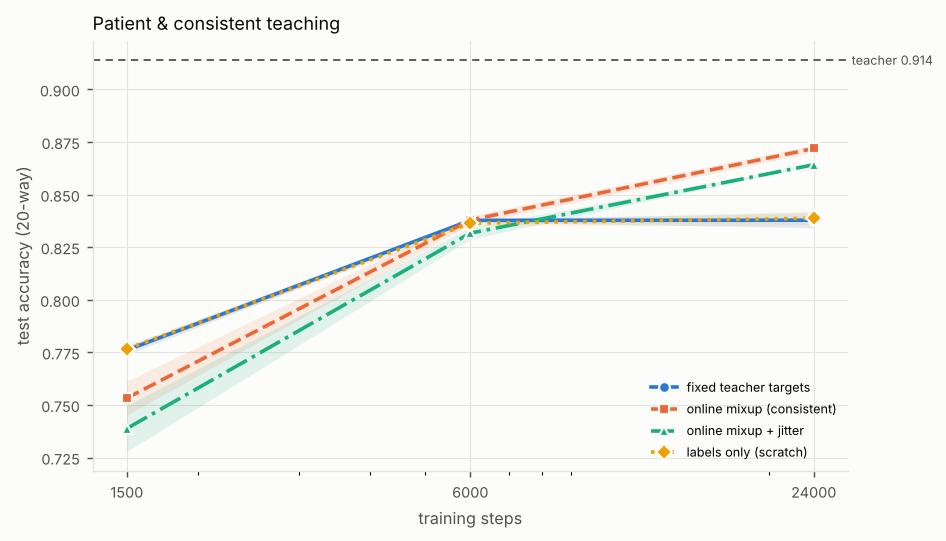
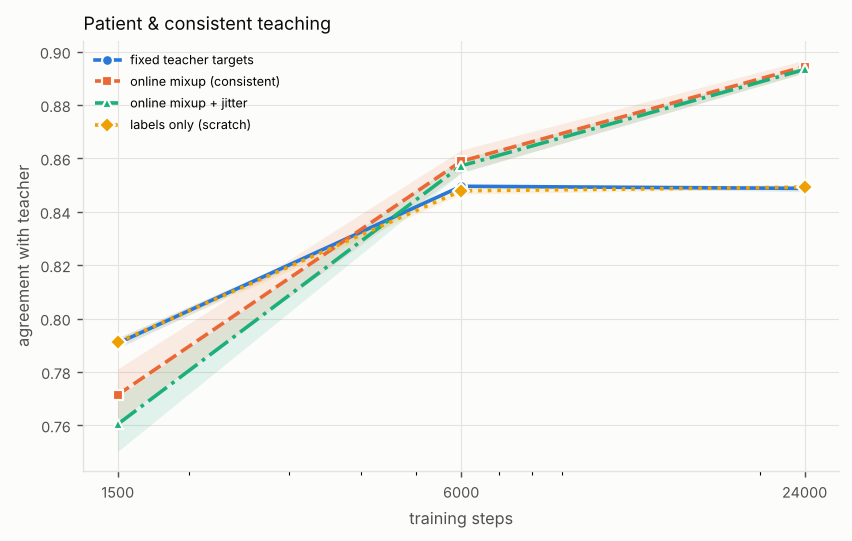
Beyer et al.: treat KD as function matching: query the teacher on fresh augmented inputs every step and train for a long time. Does it keep paying?
This figure did not load: the file is missing or the connection dropped. Reload the page to try again; the table below has the same numbers.
This figure did not load: the file is missing or the connection dropped. Reload the page to try again; the table below has the same numbers.
Table
Mean over the seeds; ± is the standard deviation where more than one seed ran. The experiment took 302 s.
| Training steps | Method | Test accuracy (20-way) | Target-class AP ('bird') | Agreement with teacher | Test NLL | KL(Bayes || model) | Parameters (nonzero) |
|---|---|---|---|---|---|---|---|
| 1,500 | fixed teacher targets | 0.776 ± 0.002 | 0.922 ± 0.001 | 0.791 ± 0.002 | 0.681 ± 0.010 | 0.601 ± 0.009 | 2,132 |
| 1,500 | online mixup (consistent) | 0.753 ± 0.008 | 0.913 ± 0.001 | 0.771 ± 0.010 | 0.731 ± 0.021 | 0.648 ± 0.021 | 2,132 |
| 1,500 | online mixup + jitter | 0.739 ± 0.011 | 0.905 ± 0.000 | 0.760 ± 0.010 | 0.781 ± 0.025 | 0.699 ± 0.025 | 2,132 |
| 1,500 | labels only (scratch) | 0.777 ± 0.001 | 0.922 ± 0.001 | 0.791 ± 0.002 | 0.680 ± 0.009 | 0.600 ± 0.008 | 2,132 |
| 6,000 | fixed teacher targets | 0.838 ± 0.001 | 0.960 ± 0.000 | 0.850 ± 0.000 | 0.513 ± 0.004 | 0.436 ± 0.004 | 2,132 |
| 6,000 | online mixup (consistent) | 0.838 ± 0.002 | 0.959 ± 0.003 | 0.859 ± 0.004 | 0.484 ± 0.004 | 0.402 ± 0.004 | 2,132 |
| 6,000 | online mixup + jitter | 0.832 ± 0.003 | 0.949 ± 0.009 | 0.857 ± 0.003 | 0.498 ± 0.006 | 0.418 ± 0.007 | 2,132 |
| 6,000 | labels only (scratch) | 0.836 ± 0.001 | 0.960 ± 0.000 | 0.848 ± 0.001 | 0.518 ± 0.003 | 0.439 ± 0.003 | 2,132 |
| 24,000 | fixed teacher targets | 0.838 ± 0.004 | 0.960 ± 0.001 | 0.849 ± 0.001 | 0.675 ± 0.030 | 0.597 ± 0.026 | 2,132 |
| 24,000 | online mixup (consistent) | 0.872 ± 0.002 | 0.974 ± 0.001 | 0.894 ± 0.002 | 0.390 ± 0.006 | 0.310 ± 0.004 | 2,132 |
| 24,000 | online mixup + jitter | 0.864 ± 0.000 | 0.971 ± 0.005 | 0.893 ± 0.001 | 0.405 ± 0.000 | 0.324 ± 0.000 | 2,132 |
| 24,000 | labels only (scratch) | 0.839 ± 0.003 | 0.965 ± 0.001 | 0.849 ± 0.001 | 0.674 ± 0.029 | 0.601 ± 0.029 | 2,132 |
Reference points
- Teacher (the large model)
- The full-size network trained on the labeled data; the smaller models here are measured against it. Test accuracy (20-way) 0.914, target-class AP ('bird') 0.989, test NLL 0.384, KL(Bayes || model) 0.309, parameters (nonzero) 140,052.
- Bayes-optimal (the best any model can do on this problem)
- Predictions from the exact class probabilities, which the lab can compute because it generated the data. Test accuracy (20-way) 0.973, target-class AP ('bird') 0.999, test NLL 0.079.
Birds in this experiment
The table's 12 smaller models hatch 2 kinds of bird. Each kind is drawn once, for one model: the smallest if the bird is healthy or bones, the one that keeps the most if it's starving.
- Ruby-throated Hummingbird, healthyTraining steps: 24,000; method: online mixup (consistent)65.6× smaller, keeps 95.4% of the teacher's accuracyThe only model of its kind
- Ruby-throated Hummingbird, starvingTraining steps: 24,000; method: online mixup + jitter65.6× smaller, keeps 94.6% of the teacher's accuracyBest of 11 models
Measured against this experiment's teacher: 140,052 parameters, 4481.7 kbit, accuracy 0.914. Storage is 32 bits a parameter, the lab's rule for a dense fp32 net, which every model drawn here is. Species follows how many times smaller a model is. A bird stays healthy while its model keeps at least 95% of the reference's score, and turns to bones at 60% or less.
These are the lab's recorded results, so they aren't added to anyone's life list. Birds you hatch yourself, in the Coop or from a Field Guide run, are saved to your life list.