The idea
Distillation does not need a bigger teacher. Furlanello et al. trained a network, then trained an identical, freshly initialized copy to match it, and found the copy was often more accurate than the original. Repeating this gives generations. The explanation usually offered is that the parent's soft outputs act as a regularizer: they tell the child which examples are ambiguous and which classes are related, so it fits the labels less rigidly.
How it works
- Generation 0: train a network of a fixed architecture on the labels.
- Generation
g: create a new network of the same architecture with new random weights. - Train it on
alpha · KD(parent) + (1 − alpha) · CE(labels), where KD compares temperature-softened outputssoftmax(z / T)of child and parent, and CE (cross-entropy) is the ordinary label loss. - The child becomes the parent; repeat.
- Evaluate every generation on held-out data. Optionally average several generations' predictions.
parent = train_on_labels(arch, seed=0)
for g in range(1, G + 1):
    parent = distill(arch, teacher=parent, seed=100 * g, T=2, alpha=0.5)
The code, line by line
born_again in lab/experiments/teacher.py runs the method for two architectures and two transfer sets.
- The outer loops cover
("2x32 (student-size)", STUDENT)and("3x256 (teacher-size)", [256, 256, 256]), thentransferin"train"(8k labeled inputs) and"pool"(plus 20k unlabeled), then two seeds (SEEDS[:2]). - Generation 0:
prev = scratch(hid, s)trains the network on labels with the same 3000-step budget every later generation gets, for both sizes, so any change across generations comes from distillation, not from a different recipe. - Each row records
ev(prev), the test metrics. - For
gin 1 to 3:cur = distill(hid, prev, seed=100 * g + s, transfer=transfer, T=2, alpha=0.5). The seed changes each generation, so the child starts from new random weights and sees batches in a new order.T=2, alpha=0.5means half the loss is KD at a mild temperature and half is CE on the labels. Withtransfer="pool", the unlabeled rows only get the KD half. ev(cur, prev)addsfidelity: how often the child's top class matches its parent's.prev = curmakes the child the next parent.agg(rows, ["arch", "transfer", "generation"])averages over seeds;serieslabels each line for the plot.
run_born_again in lab/methods.py runs one chain at the width you choose, on the labeled inputs, with seed=100 * g and the same T and alpha.
What the simulations show
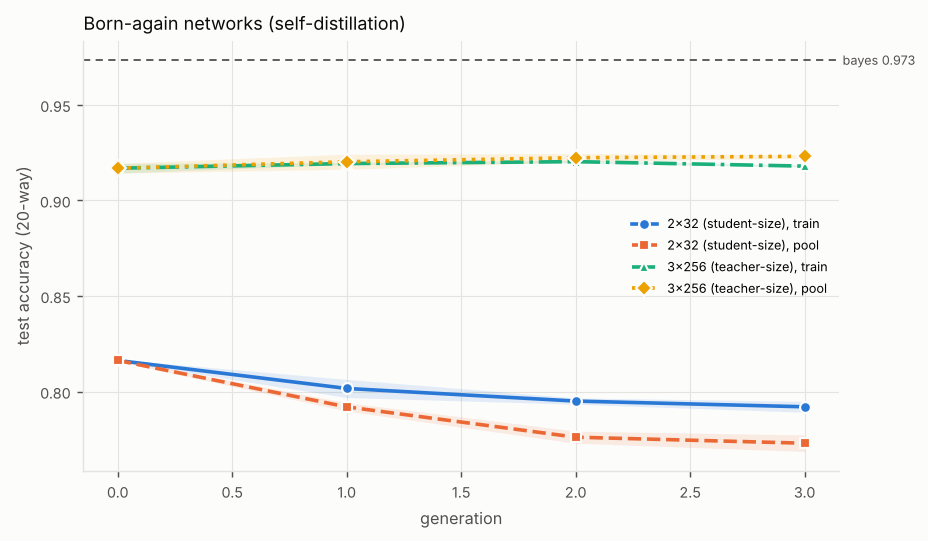
born_again (2 seeds, 3000 steps per generation, test accuracy):
| generation | 2x32, train | 2x32, pool | 3x256, train | 3x256, pool |
|---|---|---|---|---|
| 0 | 0.8163 | 0.8163 | 0.9168 | 0.9168 |
| 1 | 0.8016 | 0.7920 | 0.9193 | 0.9203 |
| 2 | 0.7951 | 0.7762 | 0.9203 | 0.9224 |
| 3 | 0.7921 | 0.7730 | 0.9180 | 0.9231 |
The small network loses accuracy every generation. The big one gains a little: with the pool it climbs every generation, on the labeled inputs alone it peaks at generation 2. Fidelity to the parent rises with each generation (2x32 on train inputs: 0.8194, 0.8383, 0.8481), so children become better copies of increasingly worse parents. A 2x32 network cannot fit this problem well, and its soft outputs encode its own errors; the KD half of the loss pulls the child toward them. The 3x256 parent is close to fitting the data, so its soft outputs mostly add calibration information: its NLL (mean negative log-probability of the true class) falls from 0.3735 to 0.3184 by generation 3 with the pool. The 3x256 gains are small next to their seed spread (up to 0.004), so treat them as a tendency.
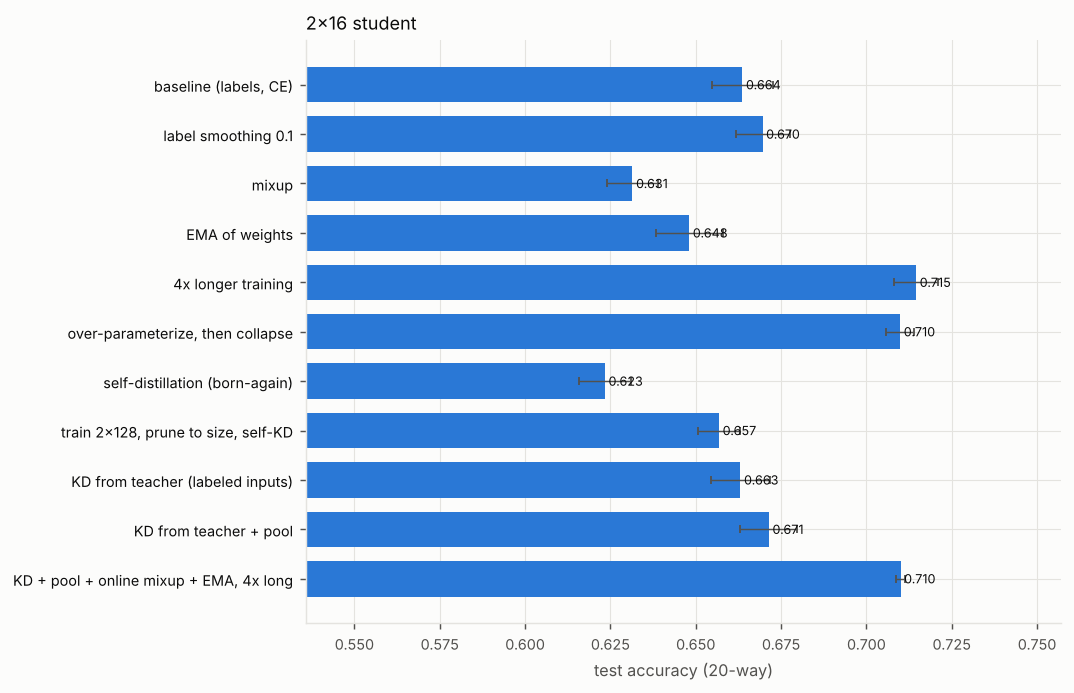
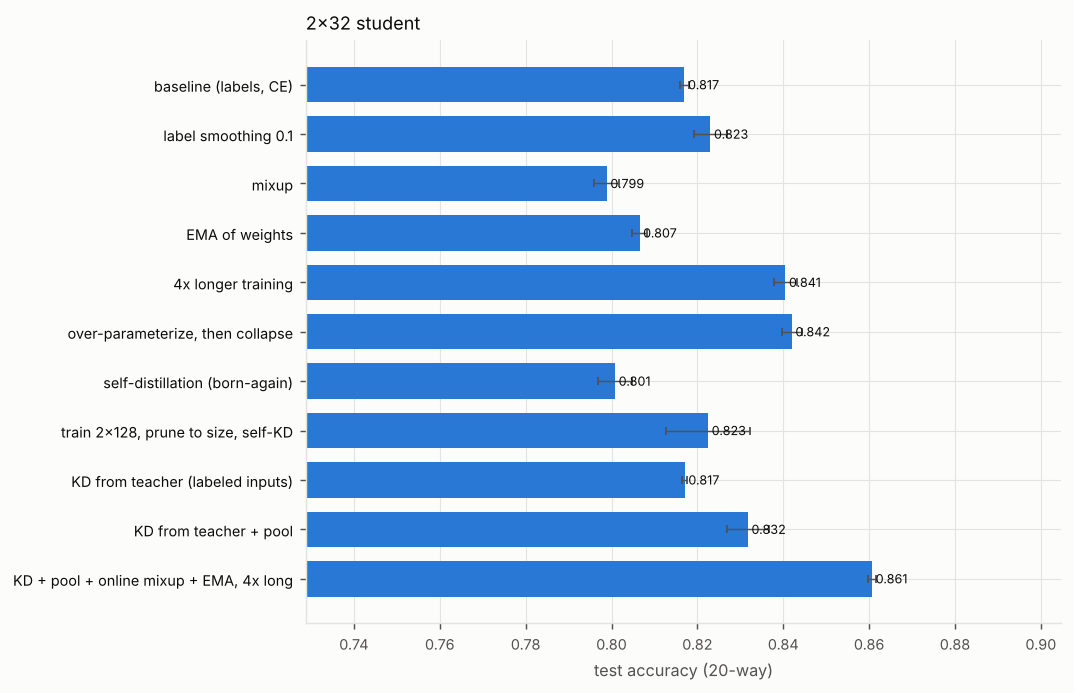
small_tricks agrees for small models: self-distillation gave 0.6234 against a 0.6637 baseline for 2x16, and 0.8008 against 0.8170 for 2x32.
This page's runs (1000 steps, seed 0). Width 32: 0.7398, 0.7032, 0.6980. Width 128, three generations: 0.9010, 0.8920, 0.8938, 0.8904. Width 8: 0.3645, 0.3437, 0.3343, 0.3893. The last generation's jump at width 8 is a single seed on a very unstable model, not a trend. At this page's short budget, even width 128 gets no benefit.
When it breaks
- Capacity-limited models: the parent's mistakes become the child's targets. Self-distillation helps models that already fit the data well.
- Short budgets: each generation is trained from scratch, so a child that has not converged is worse than its parent.
- Too much weight on KD (
alphanear 1) with a weak parent copies its errors; the labels are what keep generations anchored. - Gains are small, often within seed noise. Run several seeds before trusting a generation-to-generation difference.
- Give generation 0 the same recipe and budget as its children; otherwise the comparison measures the recipe.
Try this
- Set width to 128 and generations to 3. Compare with width 32, where the model is capacity-limited.
- Set width to 4 or 8 and watch how unstable the generations are; that variation is the noise floor for any conclusion.
- At width 64, compare generations 1 and 4 to see whether later generations keep the first one's change or drift further.
Going further
Born-again networks were reported on image classifiers (DenseNets and ResNets on CIFAR-100) that fit their training data well, the regime where born_again shows a gain for the 3x256 network. Practical variants distill within one training run: the model's own predictions from an earlier epoch, or its deeper layers teaching its shallower ones, avoiding a full retraining per generation. Allen-Zhu and Li argue self-distillation acts like an implicit ensemble of two models. In this repo, lab/experiments/teacher.py:born_again is the full method and the "self-distillation (born-again)" arm of small_tricks is the one-generation version.
Source code
The exact code that runs, read from the repository when this page was built.
born_again lab/experiments/teacher.py:156
@experiment("born_again", G, "Born-again networks (self-distillation)",
            "Can a model teach a copy of *itself* to be better? Repeat for several "
            "generations, small and big.")
def born_again():
    d = data()
    rows = []
    for arch_name, hid in [("2x32 (student-size)", STUDENT), ("3x256 (teacher-size)", [256, 256, 256])]:
        for transfer in ["train", "pool"]:
            for s in SEEDS[:2]:
                prev = scratch(hid, s)  # generation 0 gets the same budget as the rest
                rows.append(dict(arch=arch_name, transfer=transfer, generation=0, seed=s, **ev(prev)))
                for g in range(1, 4):
                    cur = distill(hid, prev, seed=100 * g + s, transfer=transfer, T=2,
                                  alpha=0.5)
                    rows.append(dict(arch=arch_name, transfer=transfer, generation=g, seed=s,
                                     **ev(cur, prev)))
                    prev = cur
    rows = agg(rows, ["arch", "transfer", "generation"])
    for r in rows:
        r["series"] = f"{r['arch']}, {r['transfer']}"
    return dict(rows=rows, refs=refs(), plots=[
        dict(x="generation", y="acc", group="series", hlines=["bayes"]),
    ])
Simulation figures
Born-again networks (self-distillation)
Can a model teach a copy of itself to be better? Repeat for several generations, small and big.
This figure did not load: the file is missing or the connection dropped. Reload the page to try again; the experiment's full table on the Results page has the same numbers.
Bag of tricks for a small model
Fixed small architecture. What actually moves its accuracy: regularizers, longer training, weight averaging, over-parameterize-then-collapse, self-distillation, a teacher, or train-big-then-shrink?
This figure did not load: the file is missing or the connection dropped. Reload the page to try again; the experiment's full table on the Results page has the same numbers.
This figure did not load: the file is missing or the connection dropped. Reload the page to try again; the experiment's full table on the Results page has the same numbers.
Papers
- Furlanello et al. Born-Again Neural Networks (2018)