The idea
A classifier outputs a probability for every class. Those probabilities say which wrong answers are nearly right: "bird, maybe a sibling class, certainly not a vehicle." A one-hot label (1 at the true class, 0 elsewhere) carries none of that. Knowledge distillation (KD) trains a small student to reproduce a big teacher's whole probability vector, using a temperature to make the small probabilities large enough to learn from.
How it works
- Train the teacher on labeled data.
- Choose a transfer set: inputs on which to query the teacher. They need no labels.
- For a batch, compute teacher logits
ztand student logitszs(raw scores before softmax). - Soften both:
pt = softmax(zt / T),ps = softmax(zs / T). LargerTflattens them so runner-up classes get visible mass. - KD loss:
T² · KL(pt ‖ ps) = T² · Σ pt · (log pt − log ps). KL divergence is zero when they agree. - Mix with cross-entropy (CE) on rows that have a label:
loss = alpha · KD + (1 − alpha) · CE. - Use the student at
T = 1at test time.
The gradient of the KL term with respect to zs is (ps − pt) / T; the T² factor keeps its size comparable across temperatures.
pt = softmax(teacher(x) / T)
ls = log_softmax(student(x) / T)
loss = alpha * T*T * sum(pt * (log(pt) - ls)) + (1 - alpha) * ce(student(x), y)
The code, line by line
softmax in lab/train.py divides by T, then subtracts each row's maximum (z - z.max(1, keepdims=True)); softmax ignores constant shifts, so this only stops exp from overflowing.
KD.__init__ stores T, a weight (this is alpha) and a kind; Hinton KD is kind="kl". For that kind KD._teacher_probs just returns softmax(tl, T).
In KD.__call__, ls = log_softmax(z, T) is the student's log-probabilities, ps = np.exp(ls) its probabilities, and lt = log_softmax(b.t_logits, T) the teacher's log-probabilities, computed exactly from its logits rather than as log of a probability that may have underflowed to 0. The loss is T * T * (pt * (lt - ls)).sum() / N, the formula above averaged over N rows. The MLP in lab/nn.py has hand-written backprop, so each loss term also returns its gradient with respect to the logits, dz = T * (ps - pt) / N, and {} for (unused) hidden-layer gradients.
distill in lab/common.py wires it together; its default is T = 1.0 (this page defaults to 4 so you can see the effect). net(student, seed=seed) builds a fresh student. transfer_X(d, transfer) returns the inputs: "train" is the 8k labeled set, "pool" adds 20k unlabeled inputs labeled -1. FixedSource(X, y, ..., teacher=t) runs the teacher once over every input and stores its logits. The terms are KD(T=T, weight=alpha, ...) plus CE(weight=1 - alpha) when alpha < 1; CE multiplies by b.lab, so unlabeled rows only feed the KD term. train fixes the number of optimizer steps, so the 28k pool does not win by training longer. run_kd compares this with scratch (labels only) at the same step count.
What the simulations show
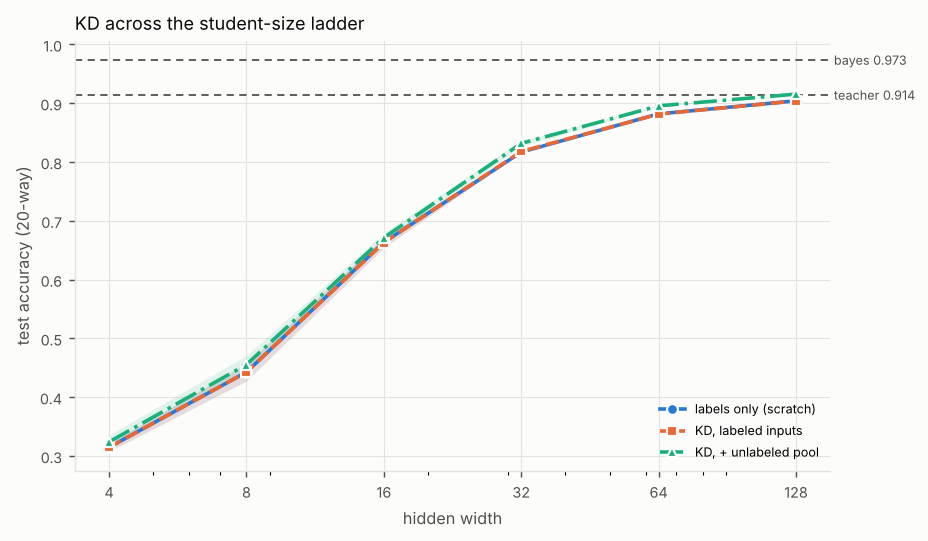
From size_ladder (3 seeds, 3000 steps, T = 1, test accuracy):
| student | labels only | KD, labeled inputs | KD, + pool |
|---|---|---|---|
| 2x8 | 0.4428 | 0.4428 | 0.4556 |
| 2x16 | 0.6637 | 0.6631 | 0.6714 |
| 2x32 | 0.8170 | 0.8180 | 0.8318 |
| 2x64 | 0.8820 | 0.8817 | 0.8957 |
| 2x128 | 0.9042 | 0.9040 | 0.9156 |
KD on the 8k labeled inputs matches labels only at every width; KD on the pool helps every width. The reason is the teacher: on its own training inputs it is 1.0 accurate with mean top probability 0.9994, so its T = 1 output there is nearly the one-hot label. On the unlabeled pool the mean top probability is 0.9684, and that is where its soft labels carry new information.
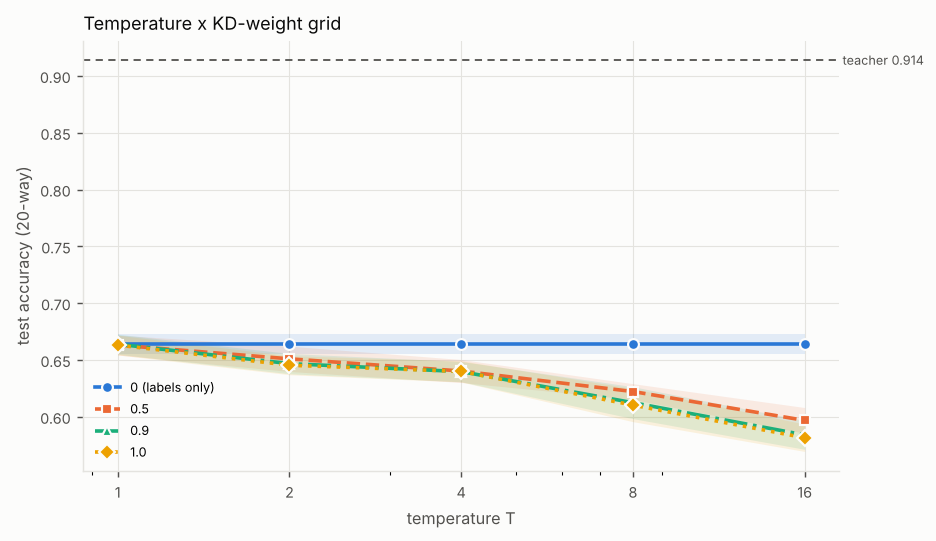
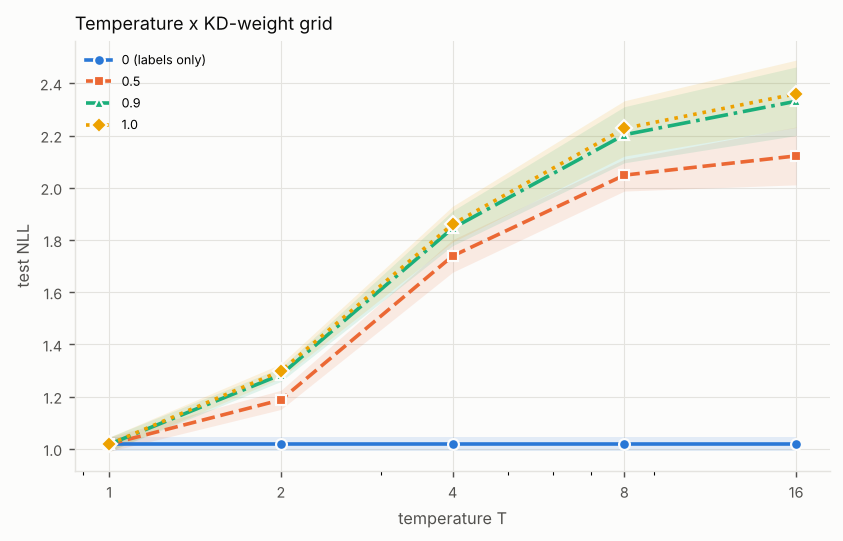
Temperature makes things worse here. In temperature_alpha (2x16, labeled inputs), T = 1 gives 0.6631-0.6639 for every alpha, and accuracy falls as T rises: 0.6399 at T = 4, 0.5815 at T = 16 (alpha = 1.0). The teacher's logits are very spread out (median max-minus-min: 47.2), so a high T asks a tiny student to copy structure it cannot represent, and it becomes overconfident: NLL (mean negative log-probability of the true class) rises from 1.0176 at T = 1 to 1.8606 at T = 4.
This page's runs (1000 steps, seed 0, pool): at width 16, labels only 0.5803, KD at T = 4 0.5551, KD at T = 1 0.5850. At width 64, labels only 0.8514, T = 4 0.8232, T = 1 0.8596. Single-seed gaps under about 0.015 are noise. The toy cannot say how a softer teacher, trained with heavy augmentation, would shift the best T.
When it breaks
- A teacher that memorized its training set gives near one-hot targets there. Distill on inputs it has not seen.
- High temperatures hurt students too small to match the teacher's logits, and damage calibration.
- The student copies the teacher's mistakes.
Try this
- At student width 16, set temperature to 1, 4, then 12. Accuracy should fall as
Trises. - At temperature 1, compare student sees = train vs pool. Only the pool should beat labels only.
- Set weight on KD (vs. labels) to 0.5 and see whether labels pull the student toward the labels-only score.
Going further
Real models use the same loss with large unlabeled or augmented transfer sets and many epochs (see the function-matching page). Teacher logits are precomputed (as FixedSource does) or computed on the fly for augmented inputs. For a detector like the cockpit's YOLOv8n the outputs are per-box class scores and coordinates, so the KD term is applied per anchor or matched box; lab/common.py:distill is the closest analogue here.
Source code
The exact code that runs, read from the repository when this page was built.
KD lab/train.py:163
class KD:
    """Match the teacher's outputs.

    kind:
      kl    -- Hinton KD: T^2 * KL(p_t^T || p_s^T)            (mode-covering)
      rkl   -- reverse KL: T^2 * KL(p_s^T || p_t^T)           (mode-seeking)
      mse   -- squared error on raw logits (T ignored)
      hard  -- CE on the teacher's argmax (pseudo-labels; no dark knowledge)
      topk  -- teacher only reveals its top-k probabilities (an API that returns
               top-k logprobs); the rest of the mass is spread uniformly
    group (C_t x C_s matrix): sum teacher probabilities into the student's
      coarser label space, e.g. 20 classes -> {bird, other} for a specialist.
    """

    def __init__(self, T: float = 4.0, weight: float = 1.0, kind: str = "kl", k: int = 3,
                 group: np.ndarray | None = None):
        self.T, self.w, self.kind, self.k, self.G = T, weight, kind, k, group

    def _teacher_probs(self, tl):
        T = 1.0 if self.kind == "hard" else self.T
        if self.kind == "topk":
            # An API reveals the top-k probabilities at T=1 and nothing else.
            # Spread the unknown remainder uniformly, *then* apply temperature.
            p = softmax(tl)
            thr = -np.sort(-p, 1)[:, self.k - 1:self.k]
            keep = p >= thr
            rest = (1 - (p * keep).sum(1, keepdims=True)) / (~keep).sum(1, keepdims=True).clip(1)
            p = np.where(keep, p, np.maximum(rest, 1e-12))
            if T != 1:
                p = p ** (1 / T)
                p = p / p.sum(1, keepdims=True)
        else:
            p = softmax(tl, T)
        if self.G is not None:
            p = p @ self.G
        if self.kind == "hard":
            p = onehot(p.argmax(1), p.shape[1])
        return p.astype(F)

    def __call__(self, z, hid, b: Batch):
        N, T = len(z), self.T
        if self.kind == "mse":
            t = b.t_logits if self.G is None else np.log(softmax(b.t_logits) @ self.G + 1e-8)
            r = z - t
            return self.w * (r ** 2).mean(), self.w * 2 * r / r.size, {}
        pt = self._teacher_probs(b.t_logits)
        if self.kind == "hard":
            loss = -(pt * log_softmax(z)).sum() / N
            return self.w * loss, self.w * (softmax(z) - pt) / N, {}
        ls = log_softmax(z, T)
        ps = np.exp(ls)
        # exact teacher log-probs when we can (log(p + eps) distorts tiny probabilities)
        lt = log_softmax(b.t_logits, T) if self.kind == "kl" and self.G is None \
            else np.log(pt + 1e-12)
        if self.kind == "rkl":
            per = (ps * (ls - lt)).sum(1, keepdims=True)
            loss = T * T * per.sum() / N
            dz = T * ps * (ls - lt - per) / N
        else:  # kl / topk
            loss = T * T * (pt * (lt - ls)).sum() / N
            dz = T * (ps - pt) / N
        return self.w * loss, self.w * dz, {}

    params = staticmethod(lambda: [])
softmax lab/train.py:30
def softmax(z: np.ndarray, T: float = 1.0) -> np.ndarray:
    z = z / T
    z = z - z.max(1, keepdims=True)
    e = np.exp(z)
    return e / e.sum(1, keepdims=True)
distill lab/common.py:149
def distill(student, t: MLP, seed: int = 0, transfer: str = "pool", T: float = 1.0,
            alpha: float = 1.0, kind: str = "kl", k: int = 3, d: Data | None = None, steps=None,
            source=None, extra_terms=(), **kw) -> MLP:
    """Train ``student`` (hidden widths or an MLP to continue from) on
    ``alpha * KD + (1 - alpha) * CE``.

    Default T=1: in this world a higher temperature makes capacity-limited
    students *worse* (see the temperature_alpha experiment), so every
    experiment that isn't about temperature distills at T=1."""
    d = d or data()
    m = net(student, seed=seed) if not isinstance(student, MLP) else student
    if source is None:
        X, y = transfer_X(d, transfer)
        source = FixedSource(X, y, d.world.C, teacher=t, hidden=bool(extra_terms))
    terms = [KD(T=T, weight=alpha, kind=kind, k=k)] + list(extra_terms)
    if alpha < 1:
        terms.append(CE(weight=1 - alpha))
    return train(m, source, terms, steps=steps, seed=seed, **kw)
Simulation figures
KD across the student-size ladder
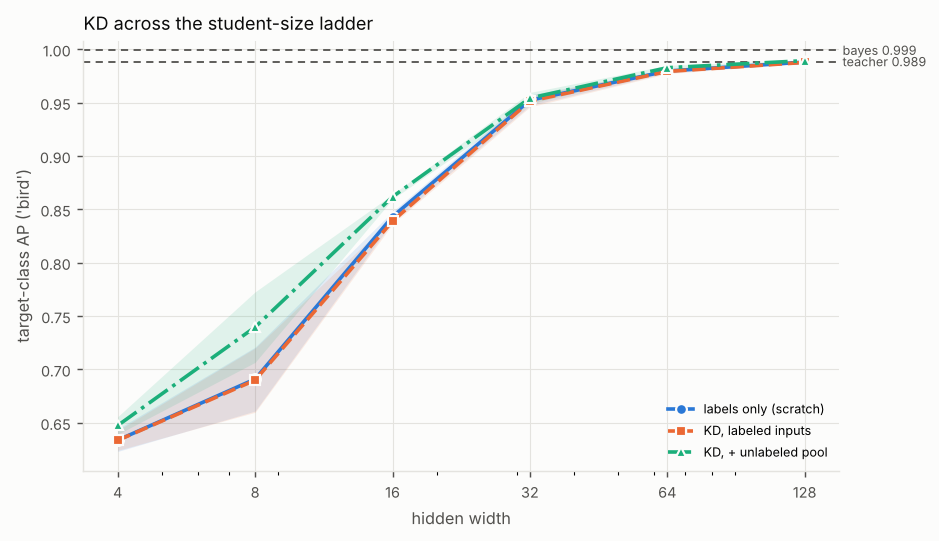
How much does distillation help at each student size, and how much of that comes from the teacher's soft labels vs. from extra unlabeled inputs?
This figure did not load: the file is missing or the connection dropped. Reload the page to try again; the experiment's full table on the Results page has the same numbers.
This figure did not load: the file is missing or the connection dropped. Reload the page to try again; the experiment's full table on the Results page has the same numbers.
Temperature x KD-weight grid
Which temperature T and what mix of KD vs. ground-truth CE (alpha) works best when the student only sees the labeled set?
This figure did not load: the file is missing or the connection dropped. Reload the page to try again; the experiment's full table on the Results page has the same numbers.
This figure did not load: the file is missing or the connection dropped. Reload the page to try again; the experiment's full table on the Results page has the same numbers.
Papers
- Hinton, Vinyals, Dean. Distilling the Knowledge in a Neural Network (2015)