The idea
If most of what a weight matrix W of shape (in, out) does happens along a few directions, it can be replaced by two thin matrices, A of shape (in, r) and B of shape (r, out), with W ≈ A B. That costs r * (in + out) numbers instead of in * out. The singular value decomposition (SVD) writes W = U diag(S) Vt, with the singular values in S sorted largest first. Keeping the top r of them gives the best rank-r approximation of W in squared error (the Eckart-Young theorem). It is best for the weights, not the outputs, so recovery still helps.
How it works
- For each layer, check that factorizing saves parameters:
r * (in + out) < in * out. - Compute
U, S, Vt = svd(W). - Keep the top
r:A = U[:, :r] * sqrt(S[:r])andB = sqrt(S[:r])[:, None] * Vt[:r]. Splittingsqrt(S)keeps the two factors at similar scales. - Replace the layer by two layers,
x -> x A -> (x A) B + b, with no nonlinearity in between. - Recover with knowledge distillation (KD) from the original net.
The code, line by line
low_rank in lab/compress.py builds a new list of layers. For each din x dout weight, the guard if i in layers and rank * (din + dout) < din * dout decides whether to factorize. For the 3x256 teacher it applies to the 256x256 hidden layers when r < 128, to the 256x20 output layer when r <= 18, and to the 12x256 input layer only when r <= 11. At rank 128 nothing qualifies, so the page returns the teacher unchanged.
U, S, Vt = np.linalg.svd(w, full_matrices=False) gives the thin SVD. A = (U[:, :r] * np.sqrt(S[:r])) scales each kept column of U, and B = (np.sqrt(S[:r])[:, None] * Vt[:r]) scales each kept row of Vt, so A @ B equals the rank-r truncation exactly. b += [np.zeros(r, F), src.b[i].copy()] gives the first factor a zero bias and the second the original one, sizes += [r, dout] records the width-r bottleneck, and lin += [True, False] marks the first factor as linear. Other layers are copied as is.
out = MLP(sizes, seed=0) is built and its weights overwritten with out.W, out.b = W, b. out.lin = lin makes MLP.forward skip the ReLU after each A. out.res and out.masks are reset, and the function reads src.W rather than src.eff(i), so residual flags, masks and quantization in the source are dropped. That is fine for the dense teacher here.
run_low_rank in lab/methods.py factorizes the teacher at the chosen rank and optionally distills it for FT = 500 steps.
What the simulations show
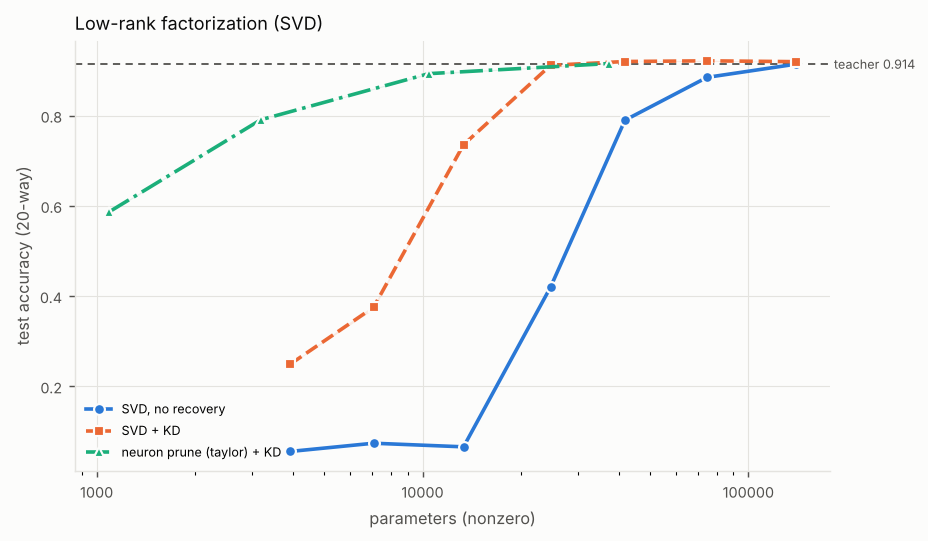
From low_rank (KD rows: 1,500 steps, mean of 2 seeds). For comparison, the same experiment prunes whole neurons (Taylor criterion) to 3xW and recovers with KD.
| rank | params | SVD, no recovery | SVD + KD |
|---|---|---|---|
| 128 (unchanged) | 140,052 | 0.9139 | 0.9194 |
| 64 | 74,644 | 0.8846 | 0.9213 |
| 32 | 41,812 | 0.7897 | 0.9197 |
| 16 | 24,708 | 0.4197 | 0.9113 |
| 8 | 13,364 | 0.0659 | 0.7354 |
| 4 | 7,076 | 0.0739 | 0.3751 |
| neuron width | params | neuron prune + KD |
|---|---|---|
| 128 | 37,268 | 0.9152 |
| 64 | 10,452 | 0.8928 |
| 32 | 3,188 | 0.7906 |
| 16 | 1,092 | 0.5865 |
(Teacher: 140,052 params, 0.9139 accuracy.) Rank 128 is the teacher itself, since no layer passes the break-even guard, yet KD "recovery" lifts it to 0.9194. Recovery is also extra training, so compare recovered rows with each other. Down to rank 16 (18% of the parameters), the factorized net recovers to about the teacher's accuracy. Without recovery, error compounds quickly: rank 16 alone keeps only 0.4197. Per parameter, the two methods trade places. Around 40k parameters SVD is slightly ahead (0.9197 at 41,812 vs 0.9152 at 37,268). Around 10-13k, neuron pruning is clearly ahead (0.8928 at 10,452 vs 0.7354 at 13,364). A rank-8 bottleneck squeezes every layer through 8 numbers, while a 3x64 net keeps 64 ReLUs per layer.
Page runs (500 recovery steps): rank 16 goes from 0.4010 to 0.8953, rank 4 from 0.0724 to 0.2728, and rank 128 from 0.9150 to 0.9192. Rank 128 starts at 0.9150 here, not the table's 0.9139: the experiment's teacher scored 0.9139, and the copy the Run button loads, trained again with the same recipe, scores 0.9150.
The toy's matrices are small; in large models many layers are closer to low rank.
When it breaks
- No savings at high rank. At or above the break-even rank
in * out / (in + out), factorizing costs parameters, which is why the guard exists. - Extra depth. Each factorized layer becomes two sequential matmuls. With few FLOPs per layer, the extra kernel launch can cost more time than the saved FLOPs.
- The wrong objective. SVD minimizes weight error, not output error. Small singular directions can still carry important inputs; activation-weighted variants (Hsu et al.) use data to fix this.
- Thin layers. The 12-input and 20-output layers barely compress and become bottlenecks at low rank.
Try this
- Set recovery to none and step rank through 64, 32, 16 and 8. Find the knee where the unrecovered model falls off.
- Set recovery to kd at rank 16 and rank 8. Compare the recovered accuracy with the Structured pruning page at a similar parameter count (width 32 or 64).
Going further
For conv layers, low-rank methods factor a k x k convolution into a k x 1 and a 1 x k convolution, or into a small conv followed by a 1 x 1 projection (Denton et al.). In language models, low rank is mostly used for adapters: LoRA trains a low-rank update instead of compressing W (see QLoRA). The YOLOv8n cockpit does not factorize layers. The closest analogue in this repo is its channel pruning (harness/prune.py), and SVD beat neuron pruning per parameter here only at mild compression.
Source code
The exact code that runs, read from the repository when this page was built.
low_rank lab/compress.py:220
def low_rank(net: MLP, rank: int, layers: list[int] | None = None) -> MLP:
    """Replace W (in x out) by A (in x r) @ B (r x out) from a truncated SVD,
    implemented as two layers with no nonlinearity in between. Only applied
    where it actually saves parameters: r * (in + out) < in * out."""
    src = net
    if any(src.res) or any(m is not None for m in src.masks) or src.qbits is not None:
        raise ValueError("low_rank expects a dense, unmasked, unquantized, non-residual net")
    layers = layers if layers is not None else list(range(src.n_layers))
    sizes, W, b, lin = [src.sizes[0]], [], [], []
    for i in range(src.n_layers):
        w = src.W[i]
        din, dout = w.shape
        if i in layers and rank * (din + dout) < din * dout:
            U, S, Vt = np.linalg.svd(w, full_matrices=False)
            r = rank
            A = (U[:, :r] * np.sqrt(S[:r])).astype(F)
            B = (np.sqrt(S[:r])[:, None] * Vt[:r]).astype(F)
            W += [A, B]; b += [np.zeros(r, F), src.b[i].copy()]
            sizes += [r, dout]; lin += [True, False]
        else:
            W.append(w.copy()); b.append(src.b[i].copy())
            sizes.append(dout); lin.append(False)
    out = MLP(sizes, seed=0)
    out.W, out.b = W, b
    out.lin = lin
    out.res = [False] * len(W)
    out.masks = [None] * len(W)
    return out
Simulation figures
Low-rank factorization (SVD)
Replace each 256x256 matrix with a rank-r product. How low can r go, and how does it compare per-parameter with deleting neurons?
This figure did not load: the file is missing or the connection dropped. Reload the page to try again; the experiment's full table on the Results page has the same numbers.
Papers
- Denton et al. Exploiting Linear Structure Within Convolutional Networks (2014)
- Hsu et al. Language Model Compression with Weighted Low-Rank Factorization (2022)