The idea
A generalist spends capacity telling 20 classes apart. If you only need "bird or not", a specialist can drop that work by shrinking its output layer (the head) to a coarser set of labels. A 2-output head (bird, rest) is cheapest. Hinton's argument for distillation suggests keeping some "what else could it be" knowledge: outputs for bird's 3 sibling classes, its usual confusers, and maybe one per other superclass. This page compares those heads at very small widths, where every output competes for capacity.
How it works
- Group the 20 classes into
Koutputs, written as a20 x K0/1 matrixGwith one 1 per row. Output 0 is always the bird alone.binary(K=2) is bird | rest.siblings(K=5) is bird | each of its 3 siblings | rest.supers(K=8) is bird | each sibling | each of the 4 other superclasses. - Build a student with a
K-wide output layer. - Distill: compute the teacher's probabilities
p_t = softmax(z_t / T)over 20 classes (hereT = 1), sum them into groupsq_t = p_t @ G, and train the student'sKoutputs to matchq_twith the usualT^2 * KL(q_t || p_s)loss. - Score by average precision (AP) of output 0 on the test set, the same single-class ranking measure the YOLOv8n cockpit uses for birds.
The code, line by line
groups in lab/experiments/specialist.py builds the three matrices. sib = world.siblings(TARGET) is [1, 2, 3], the other members of class 0's superclass, and others lists the 4 other superclasses. Each grouping is an assignment list with one output index per class. In a_sup, the bird maps to 0, a sibling c maps to 1 + sib.index(c), and any other class maps to 4 + others.index(superclass(c)). build turns the list into the matrix with Gm[np.arange(C), assign] = 1.
spec_distill trains a student in that label space. By default X is transfer_X(data()): 8,000 labeled plus 20,000 unlabeled inputs, labels unused. FixedSource(X, None, Gm.shape[1], teacher=t) runs the teacher once and stores its logits. The loss is KD(T=1, group=Gm).
Inside KD._teacher_probs (lab/train.py), p = softmax(tl, T) softens the teacher, then p = p @ self.G sums each group's probabilities. Grouping happens after the temperature. At T=1 that makes no difference, but with T > 1 a large group such as the 19-class "rest" would receive more mass than the teacher gives it. The student side is unchanged: log_softmax(z, T) over its K outputs and gradient T * (ps - pt) / N.
spec_eval calls evaluate(..., full_space=False), which reports only target_ap from output 0.
run_specialist_head in lab/methods.py adds two comparison arms. "generalist" is a 20-way 2xW student distilled normally with distill (KD over all 20 classes, also at T=1). "binary labels" trains the binary head with plain cross-entropy on yb = (d.train.y != 0), where 0 means bird, with no teacher at all.
What the simulations show
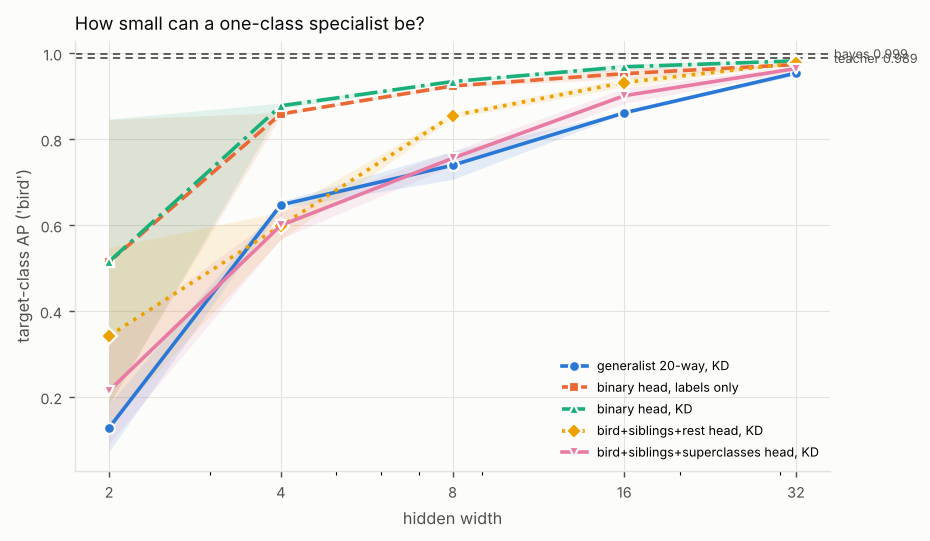
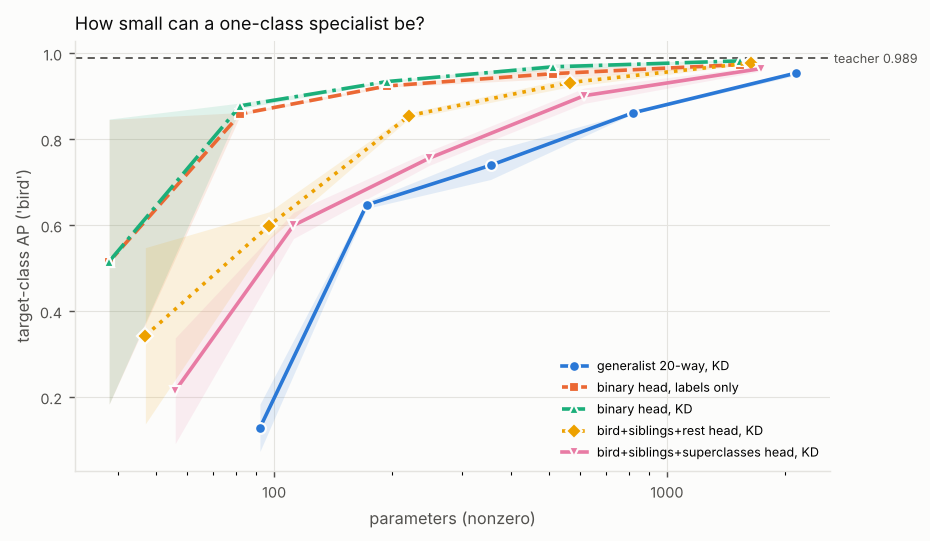
From specialist_size (bird AP, mean of 3 seeds; all KD at T=1; the teacher gets 0.9885 and the exact Bayes posterior 0.9992):
| width | generalist 20-way, KD | binary, labels only | binary, KD | siblings head, KD | supers head, KD |
|---|---|---|---|---|---|
| 2 | 0.1286 | 0.5149 | 0.5156 | 0.3428 | 0.2149 |
| 4 | 0.6475 | 0.8592 | 0.8781 | 0.5989 | 0.5998 |
| 8 | 0.7397 | 0.9243 | 0.9346 | 0.8555 | 0.7561 |
| 16 | 0.8619 | 0.9530 | 0.9689 | 0.9324 | 0.9018 |
| 32 | 0.9544 | 0.9743 | 0.9827 | 0.9779 | 0.9648 |
Specializing the head is a large win: a width-8 binary specialist (194 parameters) beats a width-16 generalist (820 parameters). But the richer heads lose to the plain binary head at every width, and the more outputs, the worse. At these sizes the extra outputs cost more capacity than their dark knowledge returns. The gap closes as width grows: at 32 the siblings head is within 0.005 of binary. Distillation adds a little over labels for the binary head (0.9346 vs 0.9243 at width 8, 0.9689 vs 0.9530 at 16). Width 2 is unstable: the standard deviation of the binary arms is about 0.33.
Page runs at width 4, one seed: generalist 0.6132, binary with labels 0.8073, binary with KD 0.8118, siblings 0.6425, supers 0.2974. The supers run is far below its 3-seed mean of 0.5998: one seed varies a lot at this size.
Superclasses here are weak structure (class centres scatter with std 1.0 around superclass centres, and each class's modes with std 2.5), so sibling knowledge may matter less than it would for real birds.
When it breaks
- Too many outputs for the width. At widths 2-8 the extra outputs cost more than they give.
- No negatives in the transfer set. The head learns "rest" only from the inputs it sees (see Recovery data for a specialist).
- Losing the other classes. A specialist cannot answer anything else later.
- Tiny widths are seed lotteries. Use several seeds.
Try this
- At width 4, run all five head settings. Rank them by
target_ap, then rerun at width 16 to see the ranking compress. - Compare head binary and binary labels at width 8. Look at whether the teacher adds anything for a 2-output task.
- Run head generalist at width 32 and binary at width 8. Compare
target_apagainst theparamscolumn.
Going further
The cockpit keeps YOLOv8n's 80-class head: its fine-tune set is built "in the model's 80-class space (bird = 14)", and the evaluator reads class 14. The cockpit README's limitations note that specializing to pigeons specifically, rather than all birds, would need a labeled dataset "and head collapse to one class". On this toy, collapsing to bird-vs-rest beats keeping outputs for the confusers. A collapsed head is also what makes task-aware pruning meaningful: once the head asks only about birds, channels that served other classes have no output left to serve.
Source code
The exact code that runs, read from the repository when this page was built.
groups lab/experiments/specialist.py:19
def groups(world) -> dict[str, np.ndarray]:
    """Label-space collapses, all with the target as output 0.

    binary    bird | everything else
    siblings  bird | its 3 superclass siblings (the confusers) | rest
    supers    bird | 3 siblings | each of the 4 other superclasses
    """
    C = world.C
    sib = world.siblings(TARGET)
    tsup = int(world.superclass(TARGET))
    others = [k for k in range(world.spec.n_super) if k != tsup]

    def build(assign):
        Gm = np.zeros((C, max(assign) + 1), np.float32)
        Gm[np.arange(C), assign] = 1
        return Gm
    a_bin = [0 if c == TARGET else 1 for c in range(C)]
    a_sib = [0 if c == TARGET else (1 + sib.index(c) if c in sib else 4) for c in range(C)]
    a_sup = [0 if c == TARGET else (1 + sib.index(c) if c in sib
                                    else 4 + others.index(int(world.superclass(c)))) for c in range(C)]
    return {"binary": build(a_bin), "siblings": build(a_sib), "supers": build(a_sup)}
spec_distill lab/experiments/specialist.py:51
def spec_distill(m: MLP, t: MLP, Gm: np.ndarray, seed: int, X=None, steps=None, lr=3e-3):
    """KD in a collapsed label space: teacher probs are summed into groups."""
    if X is None:
        X, _ = transfer_X(data())
    return train(m, FixedSource(X, None, Gm.shape[1], teacher=t), [KD(T=1, group=Gm)],
                 steps=steps, seed=seed, lr=lr)
Simulation figures
How small can a one-class specialist be?
Target-class AP vs. size for a 20-way generalist student and for specialists whose heads keep less and less of the teacher's label space.
This figure did not load: the file is missing or the connection dropped. Reload the page to try again; the experiment's full table on the Results page has the same numbers.
This figure did not load: the file is missing or the connection dropped. Reload the page to try again; the experiment's full table on the Results page has the same numbers.
Papers
- Hinton et al. (2015), 'specialist models'